The Practical Skills Behind Modern Quantum Computing Development
Introduction
Many software developers who start exploring quantum computing hit an unexpected wall: they can explain superposition and entanglement in conversation, yet stare at a blank Python file when asked to write and debug a working quantum circuit. Bridging the gap between theoretical concepts and executable code requires shifting from deterministic software engineering habits to probabilistic, linear-algebra-driven workflows.
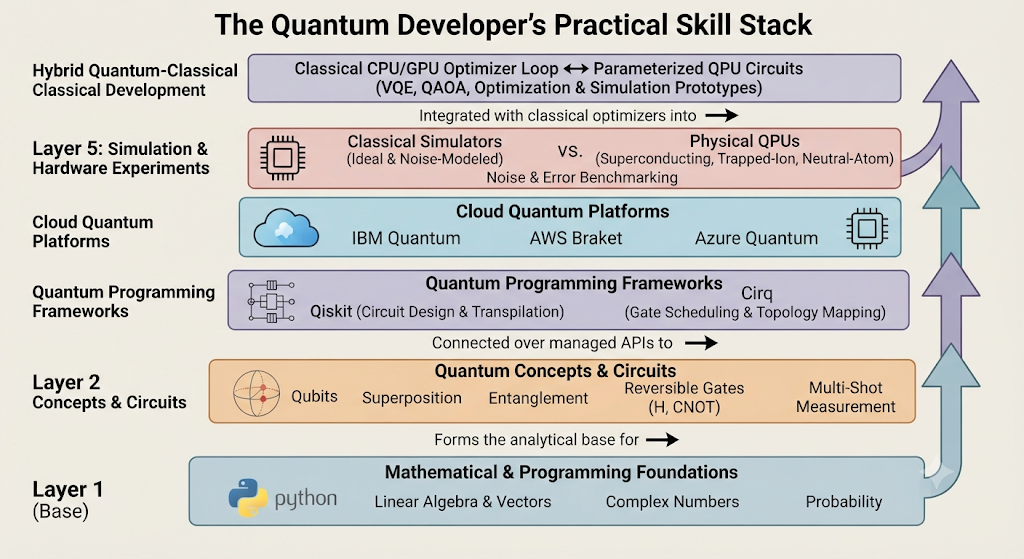
Rather than replacing classical servers, quantum processors act as specialized co-processors for narrow mathematical bottlenecks. Developing real capability in this space means mastering foundational math, open-source Python frameworks, cloud Quantum Processing Units (QPUs), and hybrid classical-quantum execution patterns.
The Knowledge Foundation
Before writing quantum code, engineers benefit from grounding themselves in four core prerequisites:
- Linear Algebra and Vectors: Quantum states are represented as unit vectors in complex vector spaces, and operations on those states are unitary matrices. Familiarity with matrix multiplication, inner products, and tensor products makes multi-qubit behavior transparent rather than mysterious.
- Probability and Complex Numbers: Qubit state amplitudes are complex numbers whose squared magnitudes determine measurement probabilities. Understanding probability distributions is essential because quantum programs output statistical samples rather than single deterministic values.
- Classical Programming Fundamentals: Modern quantum development happens primarily in Python. Fluency with virtual environments, numerical libraries like NumPy, APIs, and data visualization is essential for preparing inputs and analyzing experimental results.
- Basic Quantum Mechanics Concepts: Developers do not need experimental physics training, but they must understand state evolution, interference, and how observation collapses a quantum system into classical bits.
Understanding Quantum Operations
Quantum circuits translate mathematical transformations into step-by-step operations on quantum registers:
- Qubits: Unlike a classical bit locked at
0or1, a qubit exists in a linear combination of both basis states (|0⟩and|1⟩) until measured. - Superposition: Applying a Hadamard (
H) gate to a qubit initialized at|0⟩places it into an equal superposition. Measuring that qubit yields0or1with 50% probability each. - Entanglement: Entanglement links two or more qubits so their measurement outcomes correlate immediately, regardless of physical separation. Applying a Hadamard gate to Qubit 0 followed by a Controlled-NOT (
CNOT) gate targeting Qubit 1 creates an entangled Bell state where both qubits always measure identically (00or11). - Quantum Gates and Circuits: Unlike classical gates (
AND,OR,NOT) that overwrite bits irreversibly, quantum gates are reversible unitary transformations. A quantum circuit arranges these gates across qubit wires before final measurement. - Measurement: Measuring a qubit collapses its superposition into a classical bit. Developers run a circuit hundreds or thousands of times (“shots”) to reconstruct its underlying probability distribution.
Developing with Quantum Programming Frameworks
Open-source Python Software Development Kits (SDKs) abstract low-level hardware pulses into readable circuit definitions:
- Qiskit: Maintained by IBM, Qiskit is a widely adopted Python framework for constructing, transpiling, and optimizing quantum circuits across simulators and superconducting processors. Enrolling in a structured Qiskit programming course helps developers master hardware-aware transpilation passes, circuit optimization, and runtime primitives.
- Cirq: Created by Google Quantum AI, Cirq emphasizes fine-grained gate scheduling and topology-aware circuit design tailored for near-term noisy processors.
Working with Quantum Cloud Infrastructure
Developers do not need cryogenic laboratories to run circuits on real processors. Cloud ecosystems expose simulators and physical QPUs over managed APIs:
- IBM Quantum: Offers direct cloud access to superconducting transmon processors alongside local and cloud simulators, device calibration metrics, and Qiskit Runtime environments.
- AWS Braket: Operates as a managed multi-provider service within Amazon Web Services, allowing teams to test circuits across superconducting, trapped-ion, and neutral-atom hardware under a single SDK. Hands-on AWS Braket training teaches cloud engineers how to benchmark different hardware topologies and manage per-task and per-shot billing.
- Azure Quantum: Connects developers to diverse third-party QPU providers alongside Q#, Qiskit, and Cirq workflows, plus resource estimation tools for evaluating future fault-tolerant requirements.
Practicing with quantum cloud computing training helps engineers compare ideal simulators—which run cleanly on classical CPUs up to roughly 30–40 qubits—against physical QPUs, where shared queues, qubit connectivity limits, and physical noise alter execution behavior.
Understanding Quantum Algorithm Development
Quantum algorithms use constructive and destructive interference to amplify high-probability answers while canceling out incorrect paths. Rather than accelerating everyday tasks like web servers or relational databases, quantum algorithms target specialized mathematical structures:
- Optimization Problems: Combinatorial routing, scheduling, and portfolio constraints explored through approaches like the Quantum Approximate Optimization Algorithm (QAOA).
- Molecular and Materials Simulation: Modeling electron interactions in chemical catalysts or battery compounds using methods such as the Variational Quantum Eigensolver (VQE).
Potential Applications vs. Commercial Capabilities: Today’s processors operate in the noisy intermediate-scale quantum (NISQ) regime. While small-scale cloud experimentation and hybrid prototyping are accessible today, broad commercial advantage over optimized classical high-performance computing remains an active research and benchmarking milestone rather than an off-the-shelf production replacement.
Essential Development Challenges
Moving from toy examples to practical experimentation requires navigating several technical constraints:
- Quantum Hardware Noise: Physical qubits lose coherence quickly and suffer from gate errors and readout inaccuracies. Running the two-qubit Bell circuit above on real hardware produces small counts of
01and10alongside00and11. - Error Correction Overhead: Building fault-tolerant logical qubits requires encoding many noisy physical qubits together, consuming substantial hardware capacity.
- Circuit Depth and Scalability: Every sequential gate adds noise; circuits that are too deep degrade into random output before measurement.
- Simulator vs. Hardware Differences: Simulators allow exact statevector inspection without queue waits, whereas physical QPUs require transpiling circuits to match hardware coupling maps.
- Problem Selection: Engineers must benchmark quantum prototypes against strong classical baselines to verify whether a problem structure genuinely warrants quantum exploration.
Building Practical Experience
Developers can build hands-on fluency through a structured seven-step progression:
- Study Quantum Computing Fundamentals: Review complex numbers, vectors, matrices, superposition, and entanglement.
- Create a Basic Quantum Circuit: Design a single-qubit superposition circuit and a two-qubit Bell state on paper or in a notebook.
- Run It on a Simulator: Execute the circuit locally for 1,000 shots and verify the expected probability distribution.
- Experiment with Qiskit or Cirq: Explore multi-qubit gates, circuit transpilation, and simulated noise models.
- Explore a Cloud Quantum Platform: Configure credentials on IBM Quantum, AWS Braket, or Azure Quantum to submit jobs to cloud simulators and entry-level QPUs.
- Compare Results and Document Observations: Measure how hardware noise, gate count, and queue latency shift outputs compared to ideal simulations.
- Explore a Small Hybrid Quantum-Classical Workflow: Build a simple variational loop where a classical Python optimizer iteratively updates parameters for a shallow quantum circuit.
Structured Professional Learning
Because near-term QPUs have limited coherence windows, hybrid quantum classical computing training has become essential for practical engineering—pairing classical preprocessing and parameter optimization with targeted QPU execution.
Different IT roles approach this skill stack from distinct angles:
- Developers and Software Engineers: Focus on Python SDKs, circuit optimization, and simulator testing through dedicated quantum computing for software engineers curricula.
- Cloud Engineers and Architects: Evaluate hardware modalities, cloud orchestration, and post-quantum security readiness by pursuing a quantum computing architecture course.
- IT Managers: Build strategic literacy around realistic hardware timelines, pilot scoping, and team enablement through quantum computing for IT managers programs.
For professionals seeking guided structure, QuantumOps School serves as an India-based quantum computing education, certification, and consulting resource. Its advertised learning tracks—covering Architect, Engineer, Manager, and Professional pathways—combine instructor-led sessions, practical labs, simulations, case studies, technical assessments, and capstone projects. Completing a quantum computing certification course or earning a provider-issued QuantumOps certification helps professionals validate hands-on familiarity with cloud quantum workflows (distinct from independently accredited university degrees). For organizations evaluating pilot workloads or architectural readiness, quantum computing consulting services also offer tailored technical guidance.
Frequently Asked Questions
Do I need a physics degree to start developing quantum circuits?
No. Modern frameworks like Qiskit and Cirq abstract physical hardware pulses into gate-level logic and linear algebra. Engineers comfortable with Python, basic vectors and matrices, and probability can start building and simulating circuits immediately.
Why do quantum circuits need to run hundreds of shots?
Measuring a qubit collapses its superposition into a single classical 0 or 1. Executing a circuit across many shots builds a statistical histogram that reveals the underlying probability distribution of the quantum computation.
What is the difference between a quantum simulator and physical quantum hardware?
Simulators run on classical CPUs or GPUs, offering noise-free execution and instant feedback up to roughly 30–40 qubits. Physical QPUs run on real quantum chips, scaling past classical memory limits while introducing real-world decoherence, gate errors, and cloud queue times.
Conclusion
Quantum computing development is best approached as a disciplined extension of modern software and cloud engineering. By combining linear algebra fundamentals, Python frameworks like Qiskit and Cirq, cloud QPU experimentation, and hybrid classical-quantum workflows, IT professionals can build practical, grounded skills ready for emerging computational workloads.
Leave a Reply