Building Modern Software Platforms with AI, Cloud, DevOps, SRE, and Platform Engineering
Introduction
Modern digital businesses have outgrown the era of building applications as isolated codebases. In earlier days, an engineering team could write an application, manually install it on a virtual server, and run scheduled maintenance windows during off-peak hours. Today, software platforms are distributed systems expected to handle live data streams, deploy updates without downtime, scale on demand, and integrate artificial intelligence into customer workflows.
Delivering software in this environment requires looking beyond the application layer. Code cannot perform well without reliable infrastructure, resilient cloud environments depend on automated deployment pipelines, and continuous releases quickly compromise stability without disciplined reliability engineering. Organizations often partner with an AI Software Development Company to align these capabilities, but building durable systems requires viewing development, cloud architecture, automated delivery, platform engineering, and operational reliability as an integrated lifecycle.
How Software Development Is Changing
The software delivery lifecycle has shifted from manual, ticket-based handoffs to automated, programmable engineering systems:
- Cloud-Native Microservices: Applications are broken down into decoupled services and event-driven workloads that deploy and scale independently.
- Infrastructure as Code (IaC): Server configurations, networking routes, and storage buckets are defined in version-controlled configuration files rather than clicked through administrative consoles.
- Automated Continuous Delivery: Automated build and validation pipelines replace manual release checklists, allowing teams to ship features continuously with lower operational risk.
- Centralized Telemetry: High-cardinality distributed tracing and structured logging replace static server alerts, giving teams visibility across microservices.
- Self-Service Platforms: Internal platform teams supply pre-architected templates, allowing product developers to provision testing environments and databases without waiting on operations tickets.
When these engineering disciplines operate in isolation, organizations experience tool sprawl, deployment backlogs, and brittle production environments. Connecting them into a cohesive delivery model allows teams to move fast without sacrificing system stability.
AI and Generative AI in Software Development
Artificial intelligence is transitioning from experimental prototypes to an active operational layer within core software architecture. Teams are moving beyond basic prompt interfaces to embed machine learning pipelines, Large Language Models (LLMs), and autonomous agent loops directly into production services.
Practical business applications include:
- Retrieval-Augmented Generation (RAG): Connecting LLMs to internal knowledge repositories via vector databases (such as pgvector, Pinecone, or Qdrant) to deliver accurate semantic search without hallucination risks.
- Autonomous Workflow Agents: Building deterministic agent loops that parse user intent, query enterprise APIs, validate data structures, and automate multi-step business transactions.
- Intelligent Document Processing: Automating the extraction, categorization, and validation of unstructured text from legal agreements, technical manuals, and financial invoices.
- Natural Language Interfaces: Giving business users conversational interfaces to query relational databases and run complex analytics using plain text.
Moving from a prototype to production-grade AI introduces significant engineering constraints, including inference latency, token cost governance, and security risks like prompt injection. Leveraging specialized Generative AI Development Services helps teams integrate models into production architectures with proper caching, rate limiting, and automated evaluation guardrails.
Custom Software and SaaS Product Development
Off-the-shelf software solutions work well for standard administrative operations like corporate email or generic bookkeeping. However, when an enterprise’s competitive differentiation relies on proprietary business workflows, unique algorithms, or specialized user experiences, pre-packaged tools create severe technical constraints.
Partnering with an established Custom Software Development Company allows organizations to design applications tailored directly to their operational requirements and retain complete ownership of their data.
For teams building Software-as-a-Service (SaaS) applications, engineering decisions carry long-term scalability and compliance implications:
- Multi-Tenancy Architecture: Choosing between shared database schemas with row-level tenant keys or dedicated database instances to balance cost efficiency against data isolation requirements.
- Subscription and Entitlement Engines: Implementing billing integrations, tiered feature flags, API rate limits, and consumption metering directly into the application layer.
- API-First Ecosystems: Creating version-controlled, well-documented REST or GraphQL APIs that allow customers to automate workflows and connect third-party integrations.
- MVP Development: Launching a functional Minimum Viable Product quickly to validate market demand without accumulating technical debt that prevents horizontal scaling.
Working with an experienced SaaS Product Development Company ensures that critical architectural decisions around authentication, tenancy boundaries, and data partitioning remain stable as traffic grows.
Cloud Infrastructure and Modern Applications
Public cloud platforms—primarily Amazon Web Services (AWS), Microsoft Azure, and Google Cloud Platform (GCP)—form the infrastructure baseline for modern software platforms. However, capturing the true value of cloud computing requires intentional cloud-native architecture rather than simply lifting and shifting legacy virtual machines into managed data centers.
A resilient cloud engineering foundation rests on four core operational pillars:
- Architecture Modernization: Transitioning monolithic workloads into managed container clusters (such as Amazon EKS or Google GKE), event-driven functions, and managed database solutions.
- Infrastructure as Code (IaC): Defining virtual networks, compute instances, security policies, and storage assets in declarative configuration files using tools like Terraform or OpenTofu to eliminate configuration drift.
- Zero-Trust Security: Establishing least-privilege Identity and Access Management (IAM) controls, encrypting data at rest and in transit, and setting dynamic policy boundaries around microservices.
- FinOps Governance: Tracking infrastructure spend through resource tagging, automated right-sizing, spot instance adoption, and reserved capacity planning.
When organizations navigate complex hybrid architectures or unpredictable cloud costs, strategic Cloud Consulting Services help balance system performance with budget constraints.
DevOps and Continuous Delivery
DevOps breaks down the historical divide between software engineers who write code and operations teams who maintain system stability. Rather than passing code across functional silos, cross-functional teams take end-to-end responsibility for designing, testing, deploying, and operating applications.
Key practices of modern delivery pipelines include:
- Continuous Integration (CI): Every source code push triggers automated linting, unit test suites, dependency auditing, and container packaging within isolated runner environments.
- Continuous Delivery (CD): Validated build artifacts deploy across staging and production using progressive rollout techniques—such as canary deployments or blue-green cutovers—to limit the blast radius of unexpected bugs.
- GitOps Delivery Models: Managing system configurations and Kubernetes states through declarative Git repositories, using engines like ArgoCD or Flux to keep production environments synchronized with version-controlled code.
- DevSecOps Automation: Embedding static application security testing (SAST), vulnerability scans, and secret detection directly into deployment pipelines.
Engaging targeted DevOps Consulting Services helps organizations eliminate manual deployment checklists, standardize container configurations, and improve release frequency.
SRE and Reliability Engineering
Releasing features quickly yields little business value if deployments repeatedly degrade user experiences. Site Reliability Engineering (SRE) applies software engineering methodologies to IT operations, providing a quantitative framework to balance development speed with system stability.
Rather than aiming for unrealistic 100% uptime, SRE balances release velocity against operational risk:
- SLIs, SLOs, and SLAs: Service Level Indicators (SLIs) quantify real-time health metrics such as latency and error rates. Service Level Objectives (SLOs) establish target reliability boundaries, which in turn support customer Service Level Agreements (SLAs).
- Error Budget Governance: The acceptable operational margin below an SLO target acts as a release governor. When the error budget is healthy, developers can deploy updates quickly; if the budget is exhausted by downtime, releases pause to prioritize system stability and bug refactoring.
- Distributed Observability: Moving beyond basic CPU graphs toward distributed tracing (via OpenTelemetry) and centralized logging to isolate errors across microservice boundaries.
- Incident Response and Blameless Postmortems: Establishing structured on-call escalation paths and conducting post-incident reviews focused on addressing systemic software vulnerabilities rather than assigning individual fault.
For platforms handling high transaction volumes, professional SRE Consulting Services establish the operational guardrails required to safeguard system availability.
Platform Engineering and Developer Experience
As cloud architectures become more distributed, expecting developers to master Kubernetes manifests, cloud networking, delivery pipelines, and secret management tools causes significant cognitive overload. When engineers spend their days debugging infrastructure scripts instead of writing features, organizational velocity drops.
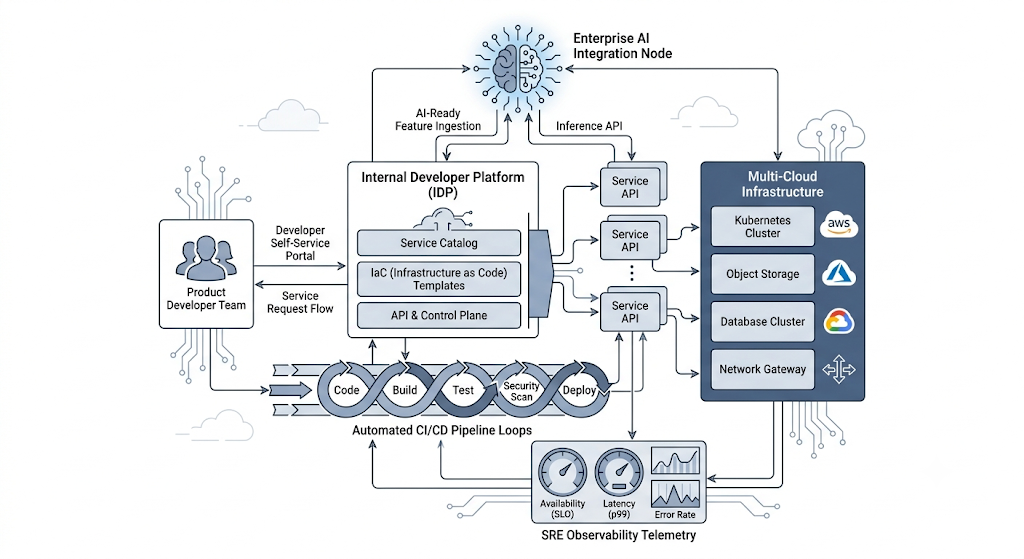
Platform engineering resolves this friction by building Internal Developer Platforms (IDPs) that offer curated, self-service access to infrastructure:
- Self-Service Infrastructure: Developers can spin up staging environments, databases, and message queues on demand without waiting for IT tickets.
- Golden Paths: Platform teams provide curated project templates pre-configured with logging, security policies, test runners, and deployment pipelines.
- Standardized Security Guardrails: Automated policy engines enforce security and compliance standards during infrastructure provisioning.
- Clear Boundaries: Application engineers focus on business logic, while platform teams maintain underlying cloud and container infrastructure.
By implementing Platform Engineering Services, organizations reduce developer friction and enable teams to ship features with greater velocity.
Connecting the Modern Engineering Stack
Modern software platforms function best when technical disciplines are structured as an interconnected stack, where each layer supports the one above it:
[ AI Applications Layer ]
         │  Embeds intelligent search, agents, and predictive workflows
         ▼
[ Custom Software / SaaS Layer ]
         │  Implements domain-driven business logic and core APIs
         ▼
[ Platform Engineering Layer ]
         │  Exposes self-service developer portals and Golden Paths
         ▼
[ DevOps & CI/CD Delivery Layer ]
         │  Automates testing, security scanning, and GitOps deployments
         ▼
[ Cloud Infrastructure Layer ]
         │  Provides elastic compute, networking, and managed databases
         ▼
[ SRE & Observability Layer ]
         │  Monitors runtime metrics, manages SLOs, and protects uptime
         ▼
[ Continuous Operational Optimization ]
Architectural Capability Comparison
| Capability | Primary Focus | Core Operational Purpose | Business Value |
| Generative AI & ML | RAG, vector databases, agent loops | Workflow automation and intelligent data processing | Improved operational efficiency and enhanced user experiences |
| Custom Software | Modular backends, APIs, domain logic | Purpose-built systems tailored to specific business needs | Direct alignment with proprietary business processes |
| SaaS Engineering | Multi-tenancy, billing, user entitlements | Scalable digital products delivered via subscription | Predictable recurring revenue and scalable customer delivery |
| Cloud Computing | AWS, Azure, GCP, managed Kubernetes | Elastic compute, storage, and networking resources | Dynamic scalability, high availability, and geographic reach |
| DevOps Automation | CI/CD pipelines, GitOps, IaC | Automated testing, packaging, and safe release cycles | Shorter deployment cycles and lower failure rates |
| Site Reliability (SRE) | SLOs, error budgets, distributed tracing | Production availability, monitoring, and incident triage | High system uptime and quantitative operational risk management |
| Platform Engineering | Internal developer platforms, Golden Paths | Self-service infrastructure and developer enablement | Reduced cognitive load and faster engineering velocity |
Practical Modernization Roadmap
Modernizing complex software architectures requires an incremental, value-focused roadmap rather than an abrupt overhaul:
- Assess the Existing Environment: Audit software architectures, infrastructure dependencies, deployment pipelines, and technical debt to establish baseline performance metrics.
- Identify Business and Engineering Bottlenecks: Pinpoint the highest-friction bottlenecks—such as slow release cycles, high cloud expenses, or operational outages—that directly impact business goals.
- Modernize Critical Applications: Refactor brittle monolithic codebases into modular, container-ready services with clean API interfaces.
- Establish Declarative Cloud Foundations: Migrate ad-hoc cloud resources to modular Infrastructure as Code using Terraform or OpenTofu, enforcing strict IAM and network controls.
- Improve CI/CD Automation: Standardize build pipelines with automated unit testing, static code analysis, container vulnerability scanning, and GitOps deployments.
- Introduce System Observability: Instrument distributed tracing across all microservices using OpenTelemetry, and aggregate logs into centralized indexing engines.
- Establish SRE Practices: Define actionable SLIs, SLOs, and error budgets for business-critical workflows to govern release velocity and uptime.
- Build Platform Capabilities: Construct self-service developer portals and provide standardized Golden Path templates to accelerate developer onboarding.
- Introduce AI for Valuable Use Cases: Deploy generative AI, RAG pipelines, or machine learning models to automate concrete business workflows and derive insights from data.
- Continuously Measure and Improve: Track key delivery metrics—such as deployment frequency, lead time for changes, and mean time to recovery—refining platforms systematically over time.
Organizations seeking to align their technology roadmap with long-term commercial goals often leverage Digital Transformation Consulting to structure this modernization journey efficiently.
Common Challenges
Modernization initiatives often encounter predictable operational pitfalls:
- Adopting Technology Without Clear Business Value: Adopting complex distributed tools when a simpler architecture would meet operational needs with less friction.
- Using Microservices Unnecessarily: Decomposing a monolith into microservices before defining clear domain boundaries, creating network latency and distributed debugging headaches.
- Treating Kubernetes as a Universal Solution: Deploying complex container orchestration for simple workloads that run more reliably on managed serverless platforms.
- Ignoring Observability: Postponing tracing, structured logging, and alert hygiene until production outages damage customer trust.
- Poor Cloud Cost Management: Provisioning elastic cloud infrastructure without resource tagging, autoscaling limits, and FinOps cost monitoring.
- Automating Inefficient Processes: Scripting flawed, manual deployment procedures instead of redesigning the underlying workflow for automation.
- Treating Security as an Afterthought: Postponing vulnerability scans and access reviews until a release candidate is ready for production.
- Building Platforms Without Developer Feedback: Constructing bespoke internal developer portals that add administrative complexity instead of surveying engineers to solve their actual daily bottlenecks.
- Treating Reliability as an Afterthought: Delaying disaster recovery drills, automated rollbacks, and incident response playbooks until an outage occurs.
- Focusing on Tools Instead of Engineering Outcomes: Investing in new frameworks and tools without addressing team culture, documentation, and operational ownership.
Building Internal Engineering Skills
Deploying modern platforms and automated pipelines delivers limited value if internal teams lack the skills to operate them effectively. Upgrading infrastructure without investing in engineering skills creates brittle platforms, single points of human failure, and expensive external dependencies.
High-performing technology organizations invest deliberately in continuous technical development across several core disciplines:
- Container and Kubernetes Operations: Hands-on training in configuring, debugging, and securing container workloads in live production environments.
- Infrastructure as Code: Writing modular, reusable configurations with Terraform, OpenTofu, or Pulumi.
- SRE and Observability Practices: Calculating actionable error budgets, instrumenting distributed traces, and running effective incident postmortems.
- AI Integration Engineering: Connecting vector databases, managing prompt pipelines, and securing APIs for machine learning models.
- DevSecOps Automation: Incorporating policy checks, container scanners, and secret managers directly into daily workflows.
Structured programs like Corporate DevOps Training provide teams with hands-on, scenario-driven experience. Upskilling in real-world sandbox environments allows engineers to master complex delivery pipelines, test failure recoveries, and manage distributed architectures with confidence.
About Cotocus.cn
Cotocus.cn works with enterprises, startups, and digital-first organizations to design, build, modernize, and operate scalable software platforms. The company provides hands-on engineering execution and strategic consulting across the entire technology lifecycle:
- AI Software Development & Generative AI: Designing custom machine learning models, autonomous agent frameworks, enterprise RAG pipelines, and intelligent workflow automations.
- Custom Software & SaaS Engineering: Building multi-tenant web applications, mobile platforms, enterprise APIs, and scalable SaaS products from initial MVP to high-scale production.
- Cloud & DevOps Consulting: Architecting secure, cost-effective environments across AWS, Azure, and Google Cloud, supported by automated CI/CD pipelines, GitOps workflows, and Kubernetes orchestration.
- SRE & Platform Engineering: Implementing system observability, SLO management, incident workflows, and self-service internal developer platforms that maximize engineering velocity.
- Digital Transformation & Corporate Training: Aligning technology strategy with business objectives and upskilling engineering teams through comprehensive, scenario-driven corporate training programs.
By combining custom application development, cloud infrastructure, automated delivery pipelines, and production reliability, organizations can build durable digital platforms that scale efficiently and adapt to changing operational demands.
Conclusion
Modern software success is not determined by any single technology. Deploying sophisticated AI models provides little business value if underlying cloud infrastructure cannot scale reliably. Similarly, migrating workloads to the cloud fails to boost release velocity if software delivery pipelines remain manual and systems lack runtime visibility.
Sustainable engineering velocity emerges when organizations combine custom software development, resilient cloud foundations, automated DevOps pipelines, self-service platform engineering, and disciplined SRE operational practices into an integrated system. Supported by continuous team upskilling and sound strategic alignment, this unified approach transforms software delivery from an organizational bottleneck into an engine for long-term innovation.
Leave a Reply