Building Modern Digital Platforms with AI, Cloud-Native Architecture, DevOps, and Kubernetes
Introduction
Modern software systems increasingly demand more than traditional application development alone. Engineering teams no longer build monoliths that sit on static servers; instead, they construct distributed platforms that must scale elastically, process streaming telemetry, integrate large language models, maintain strict security boundaries, and deliver continuous value through automated pipelines.
However, organizations frequently adopt these capabilities in isolation. Development teams build microservices in one repository, platform engineers provision cloud infrastructure in another, and machine learning specialists experiment with language models in separate sandboxes. When these disparate pieces collide in production, architectural friction emerges. Latency spikes, security gaps appear, and operational overhead balloons.
Building resilient digital platforms requires an integrated engineering mindset. Artificial intelligence, cloud infrastructure, container orchestration, CI/CD automation, security, and observability must be designed as cooperative components of a unified system rather than disconnected technology trends.
Key Takeaways
- Platform Cohesion: Modern software systems fail when AI, cloud infrastructure, Kubernetes, and application code are developed in isolation rather than as an integrated ecosystem.
- Pragmatic AI Integration: Generative AI and autonomous workflows require defined use cases, robust evaluation, and strict guardrails to succeed in production environments.
- Cloud-Native Design: Containerization, microservices, and Kubernetes deliver immense scale, but they demand operational maturity rather than blind adoption.
- DevOps as Engineering: Continuous delivery, infrastructure as code, and observability must be built into the core development lifecycle, not treated as afterthought additions.
- SaaS Scalability: Multi-tenant architecture requires deliberate isolation, security, and performance planning from the earliest MVP stages.
- Internal Capability: Long-term technology ownership depends on continuous corporate skill development across modern engineering, cloud operations, and AI.
Modern Digital Platform Architecture
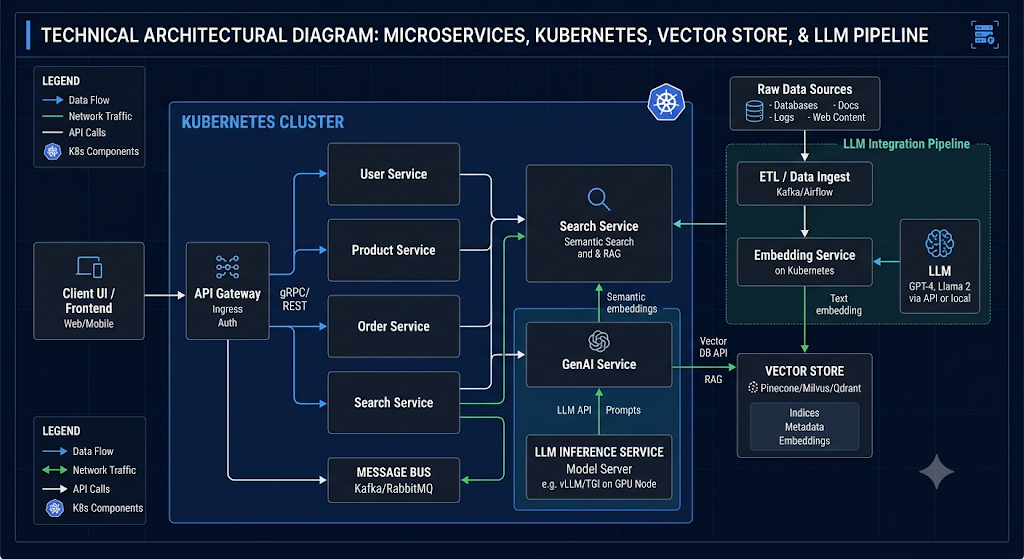
A modern software platform operates as an interconnected ecosystem of services, data stores, and automation pipelines. Rather than relying on a single monolithic runtime, distributed architectures distribute workloads across specialized functional tiers:
Users
  ↓
Web / Mobile Clients
  ↓
API Gateway / Load Balancer
  ↓
Application Services (Microservices / Modular Monolith)
  ↓
AI & Data Services ⇄ Databases & Caching Layers
  ↓
Cloud Infrastructure & Kubernetes Orchestration
Behind this runtime architecture lies the software delivery pipeline, which transforms source code into production-ready artifacts:
Source Code Repository
  ↓
CI/CD Pipeline (Build, Test, Lint, Scan)
  ↓
Container Image Registry
  ↓
Kubernetes Cluster Deployment
  ↓
Unified Observability & Telemetry
Designing these layers requires aligning architectural choices with actual operational requirements. Adopting complex distributed patterns for simple business domains introduces unnecessary failure points. Clear API boundaries, deterministic contracts, and automated validation are essential to ensure the platform scales cleanly over time.
Generative AI for Production Applications
Moving Generative AI from experimental sandbox notebooks into production enterprise systems requires transitioning from prompt tinkering to rigorous software engineering. Organizations leveraging Generative AI Development Services typically focus on domain-specific capabilities, including Retrieval-Augmented Generation (RAG) pipelines, automated document processing, enterprise knowledge assistants, and intelligent workflow automation.
Production deployment introduces technical challenges that rarely appear in proof-of-concept environments:
- Data Ingestion and Chunking: Unstructured enterprise data must be cleaned, chunked, embedded, and indexed securely into vector databases before powering retrieval pipelines.
- Retrieval Accuracy: Hybrid search mechanisms combining semantic vector search and keyword matching must return precise context to minimize model hallucinations.
- Model Selection and Latency: Engineering teams must balance cost, token throughput, context windows, and data privacy when selecting between proprietary API models and open-source weights hosted on private infrastructure.
- Continuous Evaluation: Automated testing harnesses and human-in-the-loop review loops are critical to measure output drift and response accuracy over time.
Security and access control must be enforced at the data retrieval layer, ensuring that foundation models never surface sensitive records to users lacking appropriate authorization.
AI Agents and Agentic Workflows
While standard AI applications respond directly to single user prompts, autonomous systems go a step further. Utilizing specialized AI Agent Development Services, engineering teams build goal-driven agents capable of planning multi-step execution paths, invoking external tools, querying databases, and maintaining state across extended sessions.
An enterprise agentic workflow typically incorporates:
- Intent Decomposition: Breaking a high-level user goal into sequential sub-tasks.
- Tool Orchestration: Safely interacting with authorized APIs, file systems, and internal services to gather information or execute actions.
- Memory Management: Storing short-term conversational context and long-term historical patterns without leaking sensitive data.
- Human-in-the-Loop Guardrails: Requiring explicit human approval before executing high-impact actions such as database updates, financial transactions, or infrastructure modifications.
Agents are not universally autonomous problem solvers. Without strict deterministic boundaries, clear timeouts, and rigorous output validation, autonomous loops can drift into recursive errors or infinite API calls. Successful implementations combine the adaptive reasoning of language models with the rigid reliability of traditional software validation.
Custom Software and Cloud-Native Engineering
Off-the-shelf software packages often force organizations to adapt their operations to rigid product limitations. When unique business workflows, proprietary intellectual property, or specialized scale requirements are involved, partnering with a specialized Custom Software Development Company India provides the flexibility needed to build tailored digital platforms.
Custom software engineering spans scalable web applications, robust REST and GraphQL APIs, distributed microservices, and enterprise integration layers. When designing these systems, architects frequently weigh the trade-offs of the build-versus-buy decision:
- Custom Development: Offers complete architectural control, perfect alignment with proprietary business logic, and sustainable competitive differentiation, but requires higher upfront engineering investment.
- Commercial Off-the-Shelf (COTS): Reduces initial setup time and shifts maintenance to external vendors, but introduces licensing constraints and limits deep customization.
Cloud-native applications built for custom environments take full advantage of elastic scaling, managed data stores, and decentralized service meshes, ensuring high resilience under variable workloads.
SaaS Product Development and Architecture
Building a software-as-a-service product requires a distinct engineering mindset compared to internal enterprise applications. Effective SaaS Product Development Services guide products through the complete lifecycle, moving from early validation and MVP development to resilient multi-tenant architecture and high-scale production operations.
| SaaS Area | Important Consideration |
| Multi-tenancy | Tenant isolation and scalable data segregation. |
| Database | Performance, query optimization, and logical separation. |
| APIs | Versioning, backward compatibility, and rate limiting. |
| Authentication | Identity management, role-based access, and SSO integration. |
| Deployment | Automated CI/CD pipelines and repeatable provisioning. |
| Monitoring | Application telemetry and multi-tenant performance visibility. |
A well-structured SaaS platform decouples product features from core tenancy services, enabling engineering teams to ship updates rapidly while maintaining enterprise-grade reliability and security.
DevOps and Software Delivery
Software delivery speed means little if releases introduce instability. DevOps is an engineering practice focused on removing friction between software development and IT operations through deep automation, rapid feedback loops, and shared ownership.
Engaging with DevOps Consulting Services India helps engineering organizations establish robust foundations across several disciplines:
- Continuous Integration and Continuous Delivery (CI/CD): Automated pipelines that build, test, lint, and deploy code increments safely across staging and production environments.
- Infrastructure as Code (IaC): Defining cloud environments declaratively using tools like Terraform or OpenTofu, ensuring repeatable, auditable provisioning.
- GitOps Workflows: Using Git repositories as the single source of truth for declarative infrastructure and application state.
- DevSecOps Integration: Scanning container images, dependencies, and source code for vulnerabilities early in the development pipeline rather than at the final security gate.
Automating these workflows eliminates manual human error, shortens lead times for changes, and ensures that deployments are routine, predictable events.
Kubernetes and Container Platforms
Containerization packages applications and their dependencies into standardized units that run consistently across any environment. When applications grow in complexity and scale across multiple distributed nodes, container orchestration becomes essential.
Specialized Kubernetes Consulting Services assist enterprises in designing, securing, and operating resilient container platforms. Core Kubernetes primitives include:
- Pods and Deployments: Managing container lifecycles, self-healing, and declarative scaling targets.
- Services and Ingress: Routing internal and external traffic securely to the correct application endpoints.
- ConfigMaps and Secrets: Decoupling configuration data and sensitive credentials from container images.
- Cluster Autoscaling: Dynamically adjusting underlying compute nodes based on real-time resource utilization.
Kubernetes is exceptionally powerful for complex, distributed microservices architectures with heavy scaling demands. However, for smaller monolithic applications or teams starting their cloud journey, simpler deployment architectures—such as managed container services or serverless platforms—often provide sufficient scale with significantly lower operational overhead.
Cloud Migration and Legacy Modernization
Migrating legacy workloads to modern cloud environments is rarely a simple “lift and shift” exercise. A structured migration strategy begins with thorough discovery and application dependency mapping to determine the optimal modernization path for each workload:
- Rehost: Moving applications to the cloud with minimal structural changes for rapid migration.
- Replatform: Making minor optimizations to take advantage of managed cloud services without rewriting core code.
- Refactor: Rearchitecting applications into cloud-native microservices to unlock maximum scalability and agility.
- Retire and Retain: Decommissioning redundant applications or keeping stable legacy systems running securely on-premise until a later phase.
Through professional Cloud Migration Services India, organizations modernize legacy workloads and migrate core applications to major cloud platforms with security, automation, scalability, and cost optimization built directly into the foundational architecture.
Mobile Applications and Backend Architecture
Modern mobile applications require more than responsive user interfaces; they demand high-performance client architecture backed by resilient, low-latency backend services. Whether building native iOS and Android applications or cross-platform solutions using Flutter and React Native, mobile engineering must be tightly coordinated with backend API design.
As a specialized Mobile App Development Company India, engineering teams build high-performance mobile clients connected to scalable cloud backends. Essential design considerations include:
- Efficient API Design: Implementing optimized payloads, pagination, and caching strategies to minimize battery drain and data consumption on mobile devices.
- Offline-First Synchronization: Handling intermittent network connectivity gracefully through local data persistence and automated sync queues.
- Secure Authentication: Utilizing modern token storage mechanisms, biometric verification, and secure OAuth flows.
- Real-Time Push Notifications: Managing reliable event dispatching across platform-specific notification services.
Planning mobile clients and cloud backends together prevents data bottlenecks and ensures a smooth user experience across variable network conditions.
Security, Observability and Reliability
Retrofitting security and monitoring after an application is already running in production leads to blind spots and costly remediation. Modern platform engineering bakes these capabilities into the architecture from day one:
- Identity and Access Management: Enforcing least-privilege access across all services, databases, and APIs.
- Secrets Management: Utilizing centralized, encrypted vaults for API keys, certificates, and database credentials.
- Comprehensive Observability: Gathering the three pillars of telemetry—metrics, logs, and distributed traces—into unified monitoring dashboards.
- Reliability Engineering: Defining Service Level Objectives (SLOs), error budgets, and automated incident response runbooks to maintain high availability.
Proactive monitoring and automated alerting allow engineering teams to detect and resolve anomalies before they impact end users.
Building Internal Technology Capability
Outsourcing implementation without fostering internal knowledge leaves organizations dependent on external partners for routine maintenance and evolutionary growth. Long-term digital transformation requires internal teams to develop deep, practical expertise across modern technology stacks.
Through structured Corporate AI and DevOps Training programs, enterprise teams build hands-on skills in generative AI, MLOps, Kubernetes operations, cloud infrastructure, SRE practices, and modern software engineering. Effective training bridges the gap between theoretical knowledge and real-world execution, empowering internal engineers to maintain, secure, and scale their platforms with confidence.
Technology Decision Matrix
| Requirement | Questions to Ask | Potential Direction |
| AI Application | What data and model capabilities are needed? | LLM/RAG/AI workflow |
| SaaS Product | Is multi-tenancy required? | Multi-tenant architecture |
| Cloud Migration | What is the existing workload architecture? | Rehost/replatform/refactor |
| Containers | Is deployment portability important? | Containerization |
| Kubernetes | Is operational complexity justified? | Kubernetes platform |
| DevOps | Where are delivery bottlenecks? | CI/CD and automation |
| Mobile | What application and backend requirements exist? | Native/cross-platform architecture |
Common Implementation Mistakes
- Starting AI Projects Without a Clearly Defined Use Case: Deploying language models as a novelty experiment without defining specific, measurable business outcomes.
- Treating an LLM API Integration as a Complete AI Architecture: Ignoring the need for robust retrieval pipelines, evaluation frameworks, and guardrails in production.
- Introducing Microservices Before They Are Necessary: Adopting complex distributed architectures for simple domains before the team has the operational maturity to support them.
- Adopting Kubernetes Without Considering Operational Complexity: Running container orchestrators for simple workloads where managed serverless platforms would suffice.
- Migrating Legacy Applications Without Dependency Analysis: Shifting legacy applications to the cloud without reviewing dependencies, leading to inflated cloud bills and performance bottlenecks.
- Ignoring Multi-Tenancy During SaaS Architecture Planning: Designing single-tenant prototypes that require painful rewrites to support multiple tenants safely.
- Treating Observability as an Afterthought: Relying solely on basic uptime checks instead of comprehensive metrics, structured logs, and distributed tracing.
- Automating Deployment Without Adequate Testing: Pushing code through automated pipelines without proper unit, integration, and security tests.
- Ignoring Security in CI/CD: Bolting on authentication and vulnerability scanning late in the deployment cycle rather than embedding DevSecOps from the start.
- Underinvesting in Internal Technical Skills: Relying entirely on external vendors without fostering internal platform ownership and engineering expertise.
Technology Partner Evaluation Checklist
Evaluating an engineering partner requires looking beyond marketing claims to examine core technical capabilities:
- AI engineering expertise: Proven proficiency in building RAG pipelines, fine-tuning models, and deploying agentic workflows.
- Application architecture: Ability to design scalable microservices and modular monoliths.
- Cloud expertise: Deep experience across major cloud providers for optimized infrastructure design.
- DevOps maturity: Robust implementation of CI/CD pipelines, Infrastructure as Code, and GitOps.
- Kubernetes capabilities: Skill in orchestrating secure, resilient container clusters.
- SaaS architecture knowledge: Expertise in multi-tenancy, tenant isolation, and billing integrations.
- Security awareness: Commitment to DevSecOps, least-privilege IAM, and secrets management.
- Scalability planning: Designing systems for elastic growth and high throughput.
- Mobile/backend expertise: Building responsive mobile clients backed by reliable APIs.
- Documentation: Providing thorough architecture diagrams and operational runbooks.
- Communication: Maintaining transparent, collaborative project management.
- Maintainability: Writing clean, testable code designed for long-term health.
- Knowledge transfer: Mentoring internal teams to ensure full platform ownership.
- Training capabilities: Offering structured corporate training programs.
About Cotocus
Cotocus is an AI Software Development Company India helping startups, enterprises, and digital-first businesses design, build, automate, and scale intelligent software platforms. Its Generative AI Development Services enable organizations to create LLM-powered applications, RAG solutions, intelligent automation, NLP systems, and enterprise AI workflows. Its AI Agent Development Services help businesses build autonomous and goal-driven AI agents that improve productivity, customer engagement, decision-making, and operational efficiency.
Cotocus also provides DevOps Consulting Services India for CI/CD automation, Infrastructure as Code, observability, SRE, DevSecOps, GitOps, and reliable software delivery. Through its Cloud Migration Services India, businesses can modernize legacy workloads and migrate applications to AWS, Azure, and Google Cloud with security, automation, scalability, and cost optimization built into the architecture. Its Kubernetes Consulting Services help enterprises deploy and operate secure, resilient container platforms and cloud-native applications at scale. Cotocus also operates as a Mobile App Development Company India, building high-performance iOS, Android, Flutter, and React Native applications connected to scalable backend platforms.
Conclusion
Building modern digital platforms is an exercise in careful coordination. Sustainable success does not come from adopting every new technology trend; it comes from aligning software architecture, generative AI, cloud infrastructure, DevOps automation, Kubernetes orchestration, security, observability, reliability, and human skills into a cohesive, maintainable system. By designing systems with operational clarity and strong internal capabilities, technology leaders can build resilient platforms that scale reliably into the future.
Leave a Reply