Building Sustainable Delivery Capabilities for Modern Engineering Teams
Introduction
Accelerating software delivery requires more than adopting modern toolchains. Many engineering organizations purchase licenses for continuous integration platforms, configure cloud accounts, and containerize monolithic applications, only to find that deployment velocity remains sluggish and release cycles remain unpredictable.
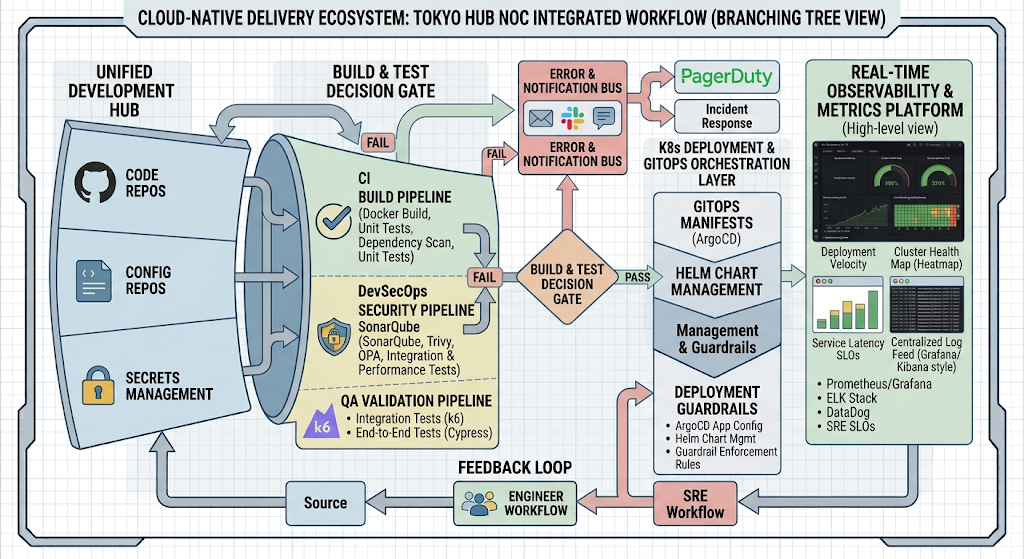
True delivery maturity is not a software license purchased off the shelf. It is an operational discipline connecting automated testing, cloud-native architecture, declarative infrastructure, systems observability, disciplined reliability engineering, and continuous security validation. When organizations treat delivery as an integrated engineering capability rather than an assortment of isolated utilities, they build systems that ship software rapidly while maintaining high availability and security.
Assessing Current Engineering Practices
Before selecting an external educational program or redesigning operational workflows, technology leaders must pinpoint the exact friction points within their existing software delivery lifecycle. Adopting complex tooling without diagnosing operational bottlenecks typically automates chaos rather than resolving it.
Common operational bottlenecks include:
- Manual Deployment Bottlenecks: Multi-step deployment checklists executed manually introduce configuration errors and prolong release windows.
- Inconsistent Environments: Differences between local development machines, staging environments, and production systems cause subtle bugs that surface only after release.
- Infrastructure Complexity: Cloud architectures created through ad-hoc clicks in administrative consoles become unmaintainable black boxes that resist auditing.
- Reliability Deficits: In the absence of actionable telemetry, engineering teams discover service degradations only after end-users report outages.
- Late-Stage Security Reviews: Security evaluations conducted at the end of delivery cycles force teams to choose between delaying product launches or deploying technical debt.
- Siloed Technical Knowledge: A small group of senior engineers holding all platform and deployment knowledge becomes an operational single point of failure.
To evaluate these constraints systematically, engineering leaders can assess their workflows by asking direct operational questions:
- How many manual intervention steps are required to move a merged pull request into production?
- Can a developer spin up a functional, isolated preview environment on demand using automated scripts?
- How quickly can the team identify the root cause of a latency spike across distributed microservices?
- Are security vulnerabilities evaluated during continuous integration, or during a gatekeeper review right before release?
- If a core platform engineer is unavailable, can other team members safely execute deployments and mitigate outages?
Resolving these issues requires technical upskilling directly aligned with genuine operational requirements. Enrolling engineers in targeted DevOps 研修 helps bridge knowledge gaps across modern version control, deterministic CI/CD pipeline design, and automated release strategies, establishing a shared technical baseline across cross-functional teams.
Building Cloud-Native Capabilities
Containerization has become the standard mechanism for packaging and isolating application workloads. However, running distributed containerized applications in production environments requires robust orchestration to coordinate networking, persistent storage, health checking, and compute scaling.
Kubernetes functions as the control plane for modern cloud-native architectures. Operating clusters safely demands hands-on competence across several architectural primitives:
- Workload Controllers: Selecting appropriate controllers, such as Deployments for stateless services, StatefulSets for clustered data stores, and Jobs for batch workloads.
- Traffic Routing and Ingress: Configuring ingress controllers, setting up internal domain name resolution, and establishing network policies to isolate sensitive namespaces.
- Resource Optimization: Defining explicit CPU and memory requests and limits to ensure multi-tenant clusters remain stable under varying traffic loads.
- Cluster Maintenance: Handling node pool updates, persistent volume claims, rolling zero-downtime application updates, and control-plane monitoring.
Navigating these operational responsibilities safely requires structured education. Comprehensive Kubernetes 研修 equips platform and application engineers with the practical knowledge needed to configure declarative pod scheduling, manage ingress routing, and troubleshoot cluster failures under production load.
Infrastructure as Code
Configuring cloud environments manually via management consoles produces undocumented architecture, configuration drift, and unrepeatable deployments. Infrastructure as Code (IaC) solves these risks by applying traditional software development rigor to infrastructure provisioning.
Using declarative tools like Terraform, engineering teams define their infrastructure topology in auditable, version-controlled text files:
- Declarative Configuration: Defining the target state of cloud infrastructure rather than writing complex, imperative shell scripts.
- State Management: Tracking provisioned assets through secure, encrypted remote state backends that support distributed locking.
- Reusable Modules: Abstracting complex VPC networks, managed database clusters, and compute groups into version-controlled modules shared across projects.
- Automated Change Verification: Generating deterministic execution plans within continuous integration pipelines, allowing peer review of proposed infrastructure modifications before applying them live.
Participating in practical Terraform 研修 enables cloud engineers to design composable modules, avoid state corruption, eliminate configuration drift across environments, and enforce consistent security policies across multi-account cloud topologies.
Reliability Engineering
Deploying code rapidly provides minimal business value if systems suffer frequent outages. Site Reliability Engineering (SRE) bridges feature development velocity and system stability by treating operations as an engineering problem solvable through software.
Key SRE practices that underpin modern software resilience include:
- Service-Level Indicators (SLIs): Identifying quantifiable metrics that reflect user satisfaction, such as endpoint latency percentiles and successful HTTP response rates.
- Service-Level Objectives (SLOs): Establishing measurable reliability targets agreed upon by both engineering and product stakeholders.
- Error Budgets: Using the mathematical gap between 100% availability and the agreed SLO to make balanced decisions regarding feature deployment speed versus stability investments.
- Reducing Operational Toil: Designing software solutions to automate repetitive, manual, non-creative operational tasks.
- Blameless Retrospectives: Analyzing root causes of outages collaboratively to discover systemic architectural and process gaps rather than assigning individual fault.
Through structured SRE 研修, operations and development engineers learn how to establish actionable telemetry architectures, implement pragmatic error budget policies, and lead effective incident response workflows.
Security Across the Delivery Lifecycle
Treating security as a final gatekeeper creates release bottlenecks and encourages teams to bypass critical checks to hit deadlines. DevSecOps restructures this workflow by embedding automated security validation into every phase of the software delivery lifecycle:
- Static Code and Dependency Scanning: Analyzing application source code and third-party dependencies for known vulnerabilities during the build phase.
- Secrets Governance: Using pre-commit hooks and repository scanning to prevent sensitive API keys, tokens, and certificates from entering version control.
- Container Hardening: Scanning base images for vulnerabilities, building minimal or distroless containers, and enforcing rootless execution.
- Policy as Code: Verifying Infrastructure as Code configurations against organizational compliance frameworks prior to resource provisioning.
- Least-Privilege Access: Applying strict identity and access management (IAM) rules that limit runtime roles to the minimum required permissions.
By undertaking structured DevSecOps 研修, engineering teams learn to build automated compliance guardrails directly into their deployment pipelines, empowering developers to identify and remediate security risks early in the development lifecycle.
MLOps for Machine-Learning Systems
As machine learning models and generative AI systems integrate into core applications, engineering teams encounter distinct operational requirements. Traditional software delivery pipelines manage deterministic application code, whereas machine-learning workloads depend on code, evolving datasets, trained model weights, and specialized hardware.
Machine Learning Operations (MLOps) adapts core delivery principles to address these complexities:
- Data and Artifact Versioning: Tracking datasets, pipeline parameters, and trained model weights to ensure full experiment reproducibility.
- Automated Training Workflows: Provisioning scalable GPU/TPU compute nodes and automating scheduled retraining workflows.
- Model Registries: Validating candidate models for inference accuracy, latency limits, and schema compatibility before production deployment.
- Inference Serving and Drift Monitoring: Deploying models onto auto-scaling container runtimes and continuously monitoring endpoints for data drift and concept degradation.
Through hands-on MLOps 研修, platform engineers and data teams learn to build reproducible pipelines, automate model deployments, and manage the full operational lifecycle of intelligent applications.
Aligning Training, Consulting, and Ongoing Support
Building sustained delivery capability requires recognizing that organizations face different challenges depending on their technical maturity, team size, and immediate business objectives. Matching the intervention format to the organization’s operational stage ensures that resources translate into measurable workflow improvements.
When an organization needs to upskill multiple teams simultaneously, investing in structured DevOps corporate training Japan establishes uniform operational standards across development, infrastructure, and security teams.
For organizations planning major infrastructure modernization or microservice migrations, engaging an experienced DevOps consultant Japan helps define robust architectural blueprints while avoiding common scaling pitfalls and security anti-patterns.
Furthermore, enterprises building out complex cloud-native platforms often rely on dedicated DevOps コンサルティング to assess delivery workflows, refactor legacy infrastructure, and establish automated deployment practices. Backing these initiatives with specialized DevOps support Japan ensures teams have rapid access to technical guidance and troubleshooting assistance when handling complex operational challenges.
A Practical DevOps Roadmap
Developing sustainable delivery capability requires an incremental, structured approach rather than an all-at-once overhaul:
- Assess: Map the software delivery pipeline from code commit to production, documenting every manual handoff, waiting period, and failure point.
- Prioritize: Highlight specific shortcomings in automation, environment consistency, testing coverage, or observability, focusing first on the highest-friction bottlenecks.
- Learn: Train engineering teams in core practices: modern version control workflows, automated testing, container fundamentals, and cloud automation.
- Implement: Create deterministic CI/CD pipelines, transition workloads to container orchestrators, and codify cloud resources using Infrastructure as Code.
- Measure: Track quantitative delivery and reliability metrics, such as deployment frequency, lead time for changes, change failure rate, and mean time to restore service.
- Improve: Regularly review performance against initial baselines, using engineering feedback to refine internal platform tooling and systematically reduce operational toil.
The appropriate roadmap depends on existing architecture, team distribution, regulatory constraints, and operational maturity.
Operational Readiness Checklist
Teams can use this checklist to assess the health and consistency of their delivery practices:
- [ ] Are deployments automated, repeatable, and executable without manual intervention?
- [ ] Is all infrastructure defined, provisioned, and managed via version-controlled code?
- [ ] Are repetitive operational tasks automated through scripts or software tools?
- [ ] Do development, staging, and production tiers share consistent architectural definitions?
- [ ] Is centralized observability available across structured logs, metrics, and traces?
- [ ] Are production outages reviewed using blameless post-incident documentation?
- [ ] Are security vulnerability and dependency checks integrated into daily CI/CD runs?
- [ ] Are secrets managed securely using dedicated external secret management systems?
- [ ] Are quantitative reliability objectives (SLOs and error budgets) defined and tracked?
- [ ] Do engineers possess the practical competencies required to operate their technical stack?
How DevOpsSchool.jp Fits Into Capability Building
For engineering teams seeking structured guidance across these technical milestones, DevOpsSchool.jp provides dedicated technology training, corporate training, consulting, implementation assistance, and operational technical support tailored to the Japanese market.
The platform assists enterprises, technical leads, and engineering teams in modernizing their infrastructure and software delivery operations. Its core areas focus on practical engineering disciplines, including foundational DevOps automation, Kubernetes cluster operations, Terraform Infrastructure as Code, Site Reliability Engineering frameworks, DevSecOps pipeline automation, and MLOps deployment architectures.
Whether an organization requires structured team upskilling, hands-on architectural consulting, or ongoing operational escalation support, DevOpsSchool.jp connects engineering teams with the technical expertise needed to build sustainable internal capabilities and operate modern cloud systems with confidence.
Frequently Asked Questions
What is the difference between DevOps and SRE?
DevOps represents a set of philosophies and organizational practices focused on breaking down silos between software development and operations teams. Site Reliability Engineering (SRE) is a practical operational methodology that applies software engineering solutions to operations challenges, using quantitative mechanisms such as SLIs, SLOs, error budgets, and deliberate toil reduction.
Why is Infrastructure as Code important for cloud environments?
Provisioning cloud infrastructure through manual console interactions creates undocumented architecture, configuration drift, and unrepeatable environments. Infrastructure as Code (IaC) ensures that all cloud resources are defined in version-controlled configuration files, enabling automated testing, peer reviews, consistent staging environments, and auditable infrastructure changes.
How does DevSecOps change traditional security reviews?
Traditional security reviews rely on periodic manual audits conducted late in the development cycle, which often delay deployments. DevSecOps integrates automated security checks—such as static code analysis, third-party dependency scanning, and container vulnerability audits—directly into developer pull requests and CI/CD pipelines, allowing teams to remediate vulnerabilities early in the delivery process.
When should an engineering organization consider adopting MLOps?
Teams should adopt MLOps practices when machine-learning models move beyond isolated research experiments into production software products. MLOps introduces automated data versioning, reproducible model training pipelines, automated evaluation checks, and production inference monitoring, ensuring AI workloads are reliable and maintainable at scale.
Conclusion
Building sustainable software delivery capabilities requires far more than adopting modern tools. It demands a deliberate synthesis of assessing existing workflows, building practical skills across engineering teams, automating repeatable processes, maintaining infrastructure consistency, strengthening reliability metrics, integrating proactive security controls, and supporting emerging machine-learning workloads.
Organizations that succeed in modernizing their delivery infrastructure focus on developing strong technical competencies within their engineering teams, establishing clear architectural standards, and selecting engagement models that match their operational maturity. By systematically addressing deployment friction, investing in ongoing technical education, and leveraging specialized resources like DevOpsSchool.jp for Japan-focused training, consulting, implementation, and ongoing operational support, engineering teams can build resilient, high-velocity delivery platforms capable of supporting mission-critical software at enterprise scale.
Leave a Reply