Navigating Assisted Reproductive Health Online: A Grounded Framework for Patient Research
Introduction
Looking into assisted conception online often begins with a simple question and quickly turns into a maze of browser tabs. A search for basic guidance yields an overwhelming mix of clinical portals, personal essays, promotional hospital packages, regional regulatory summaries, and complex statistical registries. Because information is dispersed across commercial clinic portals, non-profit registries, patient discussion boards, and cross-border medical agencies, sorting out what is objective is challenging.
In healthcare research, gathering a larger volume of pages does not automatically produce clarity. In fact, accumulating fragmented data points without context often increases anxiety while obscuring the practical details needed to make sound decisions. Developing a structured, critical mindset enables you to cut through marketing language, identify verifiable facts, and prepare meaningful discussions for upcoming clinical consultations.
Understand the Broader Medical Journey
Before evaluating specific facilities or reviewing financial estimates, it helps to understand how assisted reproduction actually unfolds chronologically. Many people jump straight to advanced laboratory procedures without recognizing the foundational diagnostic steps that guide clinical recommendations.
A standard pathway typically begins with a thorough diagnostic evaluation for both partners or the individual, examining hormonal profiles, ovarian reserve, pelvic anatomy, and seminal health. From there, medical teams formulate an individualized strategy. When proceeding with IVF treatment, the process involves multiple interdependent stages: controlled ovarian stimulation, frequent ultrasound and endocrine monitoring, egg retrieval, laboratory fertilization, embryo development, and eventual transfer, followed by careful post-procedure monitoring. Grasping this clinical sequence ensures that when you evaluate resources online, you understand exactly which phase of care an article, service, or fee schedule addresses.
Moving Beyond Advertised Figures
One of the most frustrating aspects of researching reproductive medicine is the lack of standardized pricing across websites. Published rates often present an incomplete picture, functioning as baseline figures that exclude necessary clinical procedures.
A realistic assessment of IVF treatment cost requires looking past promotional figures to account for the full spectrum of care. A comprehensive financial evaluation should account for:
- Diagnostic testing, infectious disease screenings, and baseline sonograms
- Ovarian stimulation medications, trigger injections, and luteal phase support
- Anesthesia services and surgical facility expenses during retrieval
- In vitro laboratory procedures, culture media, and extended blastocyst culture
- Cryopreservation and recurring storage fees for excess embryos or gametes
- Pre-transfer uterine monitoring and hormonal management
- Subsequent frozen embryo transfers if an initial cycle is unsuccessful
Because clinical needs vary significantly between cycles, evaluating financial realities as a comprehensive range rather than a single advertised package prevents unexpected financial strain later.
Interpreting Outcome Data in Medical Context
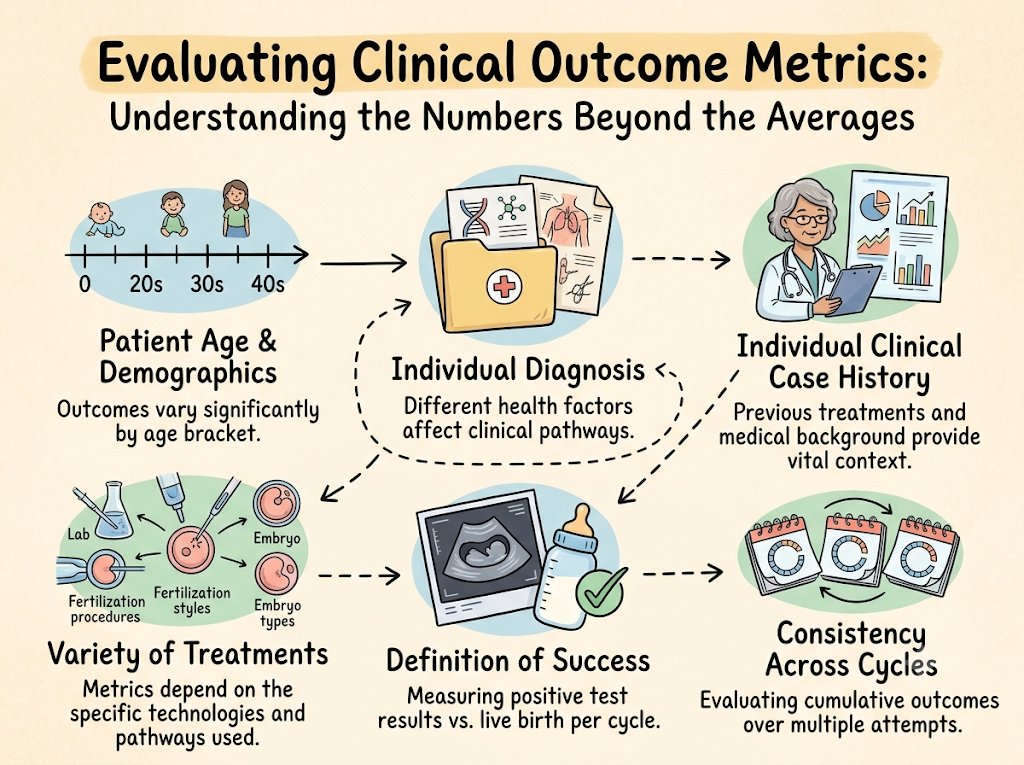
Evaluating clinical performance requires a clear understanding of biostatistics. Across healthcare literature, published IVF success rates cannot simply be accepted at face value or assumed to predict an individual’s personal outcome.
Reproductive statistics are heavily influenced by clinical and methodological variables, including:
- Patient age and ovarian reserve: Younger cohorts generally experience different statistical trends than older groups.
- Diagnostic presentation: Factors like severe male factor subfertility, advanced endometriosis, or recurrent implantation failure shift underlying metrics.
- Reporting parameters: There is a substantial medical difference between a positive chemical pregnancy, clinical pregnancy confirmation via ultrasound, and a verified live birth per started cycle versus per embryo transfer.
- Case selection criteria: Some clinics accept challenging clinical cases, which can lower their published percentages, whereas others maintain strict intake criteria to optimize outcome averages.
Looking for the reporting methodology, collection period, and institutional source behind published percentages reveals far more than relying on headline numbers.
Systematically Assessing Clinical Providers
Marketing strategies in private healthcare often emphasize luxurious facilities, proprietary techniques, or ambiguous accolades. Evaluating providers objectively requires focusing on measurable standards of clinical practice and transparent communication.
When reviewing potential IVF clinics, collect data systematically across consistent operational metrics rather than relying on subjective marketing claims. Consider whether the facility clearly identifies its laboratory directors and clinical embryologists, openly publishes its protocols for handling samples, and provides transparent financial disclosures prior to intake.
Learning how to systematically compare fertility clinics on objective variables—such as laboratory capabilities, on-site emergency resources, monitoring flexibility, psychological support services, and clear communication practices—gives you an organized way to assess quality before scheduling an initial consultation.
Evaluating Cross-Border Medical Options
Disparities in domestic healthcare systems, legal frameworks, and procedural availability prompt many individuals to consider IVF abroad. Exploring international care can offer alternative solutions, but it also introduces unique logistical, emotional, and legal considerations that require careful analysis.
Looking at the broader IVF cost by country involves far more than comparing the price of medical procedures. An objective international evaluation must account for:
- Extended travel, lodging, local transportation, and living expenses during multi-week stimulation and monitoring periods
- Legal jurisdictions governing parentage, donor anonymity, and embryo disposition
- Standards for cross-border shipping of biological specimens
- Continuity of care between local physicians and overseas medical teams
- Language barriers, cultural approaches to patient care, and emergency protocols in an unfamiliar healthcare setting
A cross-border pathway should be evaluated holistically, balancing potential procedural savings against the total logistical investment and emotional toll of managing medical treatment away from home.
Exploring Advanced Laboratory Procedures
Assisted reproduction includes diverse laboratory techniques designed to address distinct biological factors. Understanding these interventions helps you follow clinical conversations without self-diagnosing.
For individuals seeking to delay childbearing for personal, professional, or medical reasons, egg freezing serves as an established method of gamete cryopreservation. This process relies on controlled stimulation and retrieval protocols to preserve unfertilized oocytes for future use, with outcomes closely tied to the patient’s biological age and ovarian reserve at the time of retrieval.
Inside the embryology laboratory, specialized fertilization methods may be recommended based on specific diagnostic indications. For instance, ICSI treatment (intracytoplasmic sperm injection) involves directly injecting a single selected spermatozoon into a mature egg. While particularly valuable in cases of severe male factor subfertility, previous fertilization failure, or specific cryopreserved samples, it represents a targeted laboratory technique rather than a universal necessity for every assisted cycle.
Understanding the Spectrum of Care
Assisted reproduction is not a one-size-fits-all medical pathway. Familiarizing yourself with the broader spectrum of fertility treatment options—ranging from conservative lifestyle modifications and ovulation induction to intrauterine insemination (IUI) and donor-assisted cycles—allows you to approach discussions with your care team with realistic expectations.
Recognizing that clinical recommendations change based on individual diagnostic findings keeps your research grounded. The goal of independent research is not to choose your own protocol, but to understand medical rationale so you can participate actively in your care decisions.
Finding Structured Research Tools
Consolidating information across hundreds of disjointed portals can be exhausting. Utilizing dedicated, non-provider research platforms can simplify this preliminary work.
Platforms such as IVFHospitalsNow function as independent fertility-care education, research, and provider-discovery resources. By providing structured overviews of treatment pathways, underlying conditions, diagnostic procedures, medications, financial considerations, published clinical outcomes, physician directories, facility locations, and international healthcare logistics, the platform helps readers organize their findings in one centralized place. Engaging with an independent educational resource helps you structure your preliminary notes, identify knowledge gaps, and formulate well-organized questions for your physician.
Provider Comparison Table
| Research Factor | What to Check |
| Treatment | Procedures, services, laboratory capabilities, and general care process |
| Cost | Baseline procedural fees, required medications, add-on testing, and storage rates |
| Outcomes | Data sources, patient demographic adjustments, reporting dates, and clinical definitions |
| Provider | Physician credentials, laboratory accreditation, transparency, and operational protocols |
| Location | Proximity for frequent monitoring, facility accessibility, and local follow-up care |
| International Care | Cross-border legal frameworks, total travel expenses, and medical record coordination |
Simple Research Workflow
- Define: Clarify the specific questions, clinical terminology, or administrative procedures you need to understand before searching.
- Research: Collect information from accredited medical associations, peer-reviewed clinical literature, and structured educational platforms.
- Verify: Check publication dates, scrutinize author credentials, review institutional affiliations, and trace data back to primary scientific sources.
- Compare: Evaluate facilities and care pathways across uniform clinical, financial, and logistical criteria rather than promotional materials.
- Question: Compile an organized list of specific inquiries, edge cases, and uncertainties identified during your reading.
- Consult: Review your compiled questions, health history, and personal preferences directly with a qualified reproductive endocrinologist.
- Decide: Finalize clinical directions alongside licensed medical professionals, using your research to support an informed choice.
Information-Quality Checklist
- Check who published the information, verifying whether the author is an accredited clinician, institutional researcher, or marketing entity.
- Look for citations from recognized medical societies, peer-reviewed journals, or official regulatory bodies.
- Confirm that publication and clinical review dates are current, ideally within the last one to two years.
- Distinguish clearly between objective educational explanations and commercial marketing intended to promote a specific clinic or service.
- Seek out context behind statistical claims, including sample sizes, demographic parameters, and verified reporting methods.
- Cross-check clinical claims across multiple independent, high-authority medical resources.
- Treat absolute guarantees, proprietary miracle methods, or promotional discounts with healthy skepticism.
- Use online information solely to inform discussions with qualified medical professionals, not as a replacement for diagnosis or medical advice.
Conclusion
Navigating fertility information online can easily feel overwhelming, but approaching the process with a clear research framework makes a significant difference. Taking time to understand the clinical steps of the care journey, look beyond baseline advertised fees, interpret clinical statistics within their proper demographic context, and compare facilities on verifiable operational standards helps you cut through digital noise. Similarly, evaluating international pathways holistically, understanding how advanced laboratory technologies work, and verifying digital sources against established clinical literature keeps your expectations realistic and your research focused.
Using independent education, research, and provider-discovery platforms like IVFHospitalsNow allows you to systematically organize clinical and logistical details in one place. By approaching online research as a tool for preparation rather than a substitute for professional clinical advice, you can enter your medical appointments informed, focused, and ready to advocate for your care.
Leave a Reply