A Practical Guide to Better Financial Awareness and Expense Management
Introduction
True control over money does not start by cutting out every small comfort or sticking to an impossible savings plan. Rather, genuine financial balance begins with awareness—gaining an unvarnished view of where your money actually goes each day. When outgoing funds are not monitored, even solid earnings can disappear into a blur of forgotten subscriptions, unplanned purchases, and uncoordinated lifestyle costs.
Balancing a modern budget requires looking at several moving pieces: regular income, everyday living costs, recurring software, emergency buffers, and modern payment risks. Whether you are budgeting for a family household, working as an independent freelancer, or coordinating funds for a growing venture, establishing clear visibility replaces anxiety with actionable facts. Taking a systematic approach enables you to make informed decisions that support your broader life and work goals.
Understand Everyday Spending
To gain meaningful control over daily cash flow, it helps to organize transactions into clear, functional buckets. A reliable method divides expenditures into essential costs (rent, groceries, basic utilities), discretionary lifestyle spending (dining out, entertainment, shopping), existing debt obligations, long-term savings, and occasional irregular costs like annual vehicle insurance or holiday travel.
Looking at your spending over just a single week rarely reveals the entire picture. Reviewing records across several weeks or months highlights seasonal spikes, repetitive leaks, and the subtle lifestyle creep that single snapshots miss. Many people choose to log transactions using simple physical notebooks, spreadsheets, or digital tools. Exploring an expense tracker in India option can give you a practical structure for categorizing transactions, though no system produces positive financial outcomes on its own without consistent habits and honest recordkeeping.
Build a Realistic Budget
A workable budget must reflect actual daily reality rather than optimistic assumptions. Start by establishing your dependable, net monthly earnings after taxes and deductions. Next, subtract fixed baseline obligations, allocate realistic allowances for variable living costs, set aside dedicated funds for an emergency cushion, and assign small monthly amounts toward irregular annual bills. Leaving a sensible margin between planned expenses and total income prevents minor emergencies from throwing off your entire budget.
Finding an effective tool often involves trying different methods until you find what fits. Exploring a budget planner app India can introduce you to platforms built around envelope budgeting, zero-based allocations, or basic cash-flow logging. Regardless of the workflow you select, the best system is simply the one you can stick with long-term. A well-designed personal finance app India should adapt to your personal record-keeping style, protect your data, and provide clear insights without forcing you into complicated setups.
Review Subscriptions and Recurring Payments
Automatic billing makes subscribing to media, software, and memberships convenient, but automated renewals easily fade from memory. Small recurring debits—whether for video streaming, fitness memberships, digital cloud storage, or mobile utility add-ons—quietly accumulate into significant monthly costs when left unchecked. Without regular audits, you risk paying for abandoned platforms, unannounced price hikes, or duplicate services.
Set aside time every quarter to review all active memberships. Check upcoming renewal dates, evaluate actual usage, confirm cancellation rules, and identify overlapping services across family members or work tools. Searching for an intuitive subscription tracker in India can help you discover dedicated tools to keep renewal calendars organized. Using a structured recurring payment tracker makes it easy to catalog billing schedules in one place, verify real-world value, and cancel unused services before the next automated billing cycle runs.
Monitor Startup Expenses and Cash Runway
For startup founders and small business operators, cash management is essential for survival. There is a distinct difference between monthly operational burn and overall operational runway. Monthly burn rate represents the actual cash deficit your venture incurs each month after incoming revenue, while runway measures the total number of months your venture can operate before running out of capital.
Founders must clearly separate their major cost categories: payroll, server infrastructure, marketing campaigns, external contractors, software tools, and administrative costs. Using a dedicated startup burn rate calculator provides an organized way to estimate cash consumption based on verified figures. In addition, applying a startup runway calculator allows leadership teams to project survival timelines across different business scenarios. Keep in mind that these tools produce estimates rather than guarantees; changing sales cycles, delayed client receivables, and unexpected overhead will always alter actual outcomes.
Manage Business Software Costs
As business teams scale, digital tools often multiply unchecked across departments. Marketing, customer support, sales, and development units frequently onboard isolated platforms, resulting in duplicate software, forgotten user seats, and untracked auto-renewals. Systematically auditing digital applications ensures that your technology stack supports current operations efficiently.
Adopting structured SaaS spend management practices allows finance teams to catalog vendor contracts, analyze active license counts, compare renewal dates, and audit real-world feature adoption. Rather than cutting tools arbitrarily, evaluate applications based on operational dependency, team workflow disruption, data migration friction, and business value. A thoughtful software audit eliminates inactive seat fees and overlapping capabilities while keeping critical security, communication, and development tools fully intact.
Recognize Digital Payment Risks
Modern payment platforms deliver unmatched transaction speed, but rapid fund transfers also introduce real security vulnerabilities. Common threats range from deceptive payment requests and deceptive phishing messages to social-engineering phone calls, fake banking alerts, and deceptive requests to download remote-access apps. Fraudsters frequently manipulate urgency, claiming an account is suspended or a refund is pending to rush victims into mistakes.
Prioritizing everyday UPI fraud prevention begins with strict personal security habits. Always remember that your secret PIN is entered solely to transfer money out of your account, never to receive incoming funds. Never share verification codes, approve unexpected collect requests, or follow unverified support links sent via messaging applications. While vigilant habits reduce your exposure, no single habit guarantees complete safety. If you suspect unauthorized access or payment fraud in India, immediately contact your financial institution to freeze the relevant instruments, and promptly file a report through the National Cyber Crime Reporting Portal (cybercrime.gov.in) or call the national cyber helpline at 1930.
Understand Financial Well-Being
Evaluating your financial condition requires a broader perspective than simply monitoring the balance in your checking account. True resilience involves a balance of steady cash flow, manageable debt commitments, reliable savings habits, adequate emergency cash reserves, and minimal exposure to unforeseen liabilities. Overemphasizing one metric while neglecting others creates a misleading impression of security.
Some platforms condense these diverse financial factors into an overall financial health score. Such metrics serve as helpful visual indicators of your overall discipline, highlighting areas that may need attention, such as high credit utilization or thin emergency buffers. However, an automated score is only an estimate and should never be viewed as a definitive summary of your real-world financial standing.
A Practical Monthly Review Checklist
Consistency is far more valuable than sporadic, complicated financial reorganizations. Use this monthly review checklist to keep your personal or venture finances structured:
- Record all incoming revenue and everyday expenditures across all accounts.
- Separate essential requirements from discretionary, non-critical spending.
- Check scheduled recurring charges and note upcoming billing dates.
- Identify duplicate tools, underused memberships, and inactive user seats.
- Update the monthly budget based on recent patterns.
- Reassess startup or business expenses where relevant.
- Review contributions toward your savings targets and emergency funds.
- Check for suspicious payment activity and unexpected bank debits.
- Record decisions and follow up on unresolved issues promptly.
Frequently Asked Questions
How MoneyVoid.com Fits Into Financial Awareness
Building sustainable financial clarity requires structured tools that respect personal privacy. MoneyVoid.com is an independent personal and business finance platform currently under development, created to give individuals, households, and business operators clear visibility into their daily cash movements. Its planned development focuses on expense awareness, recurring-charge monitoring, startup financial planning, practical scam education, and broad financial assessments.
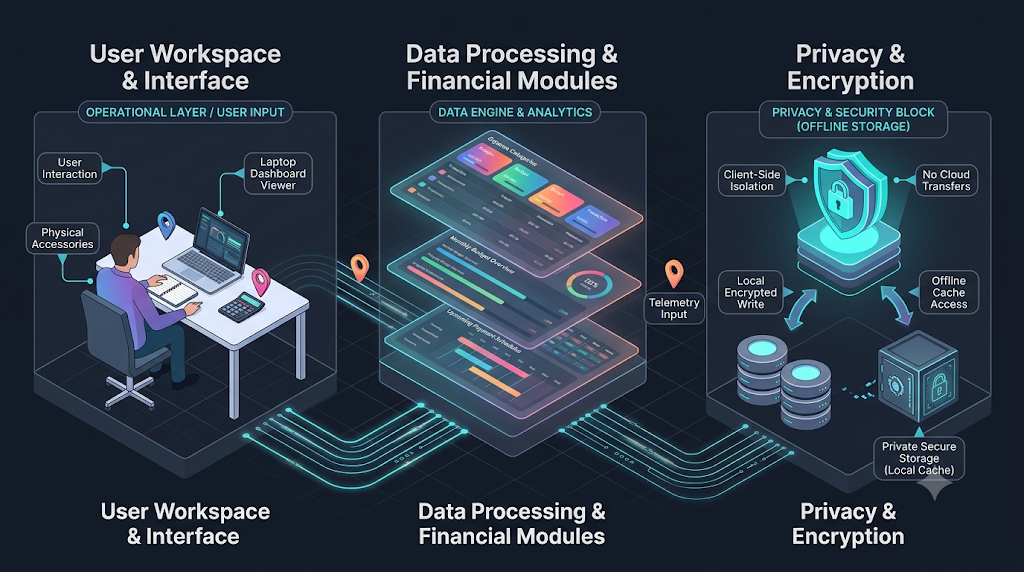
To prioritize user privacy and data security, early versions of MoneyVoid.com emphasize user-managed manual expense logging and offline CSV imports rather than requiring direct bank logins or sensitive passwords. The platform is being built to help users spot unnoticed spending trends, track digital commitments, and understand online payment risks without surrendering control of their credentials. MoneyVoid.com is actively in development, does not operate as a financial institution or registered advisory service, and provides structured frameworks rather than guaranteed financial results.
How should a beginner start tracking monthly expenses?
Start simply by recording every transaction for thirty days without trying to restrict your habits immediately. Use a plain notebook, a basic spreadsheet, or a dedicated expense tool to log the date, amount, and category of each purchase. Gathering accurate baseline records first gives you the real information you need to design a realistic, sustainable budget.
How often should I review my recurring payments and subscriptions?
Conducting a brief subscription review once every three months is an effective schedule. Quarterly audits give you enough time to recognize whether you are actually using active services, spot unexpected price adjustments, and cancel redundant memberships before annual or monthly renewals process automatically.
How can an early-stage founder estimate cash runway accurately?
Calculate your net monthly burn by subtracting steady cash receipts from total operating costs. Divide your current available cash balance by that net burn figure to estimate remaining operating months. Revisit these calculations monthly using conservative revenue assumptions and verified payroll, hosting, and operational expenses.
What should I do immediately after suspecting UPI fraud?
Immediately reach out to your bank or payment provider to block your account, freeze the compromised handles, and stop further transactions. Gather transaction references, phone numbers, and message screenshots, then report the incident through the national cybercrime portal (cybercrime.gov.in) or dial 1930 for official guidance in India.
Conclusion
Attaining lasting financial stability is an ongoing practice supported by accurate recordkeeping, thoughtful budgeting, routine subscription reviews, and sensible digital payment precautions. Whether you are budgeting for a family home or balancing runway for an emerging company, replacing unverified assumptions with documented financial facts is the most effective way to protect your resources. As platforms like MoneyVoid continue development to offer privacy-conscious spending analysis and expense organization tools, cultivating your own foundational habits remains the first and most critical step toward sustainable financial clarity.
Leave a Reply