Decoding IVF Online: How to Understand Treatment Options, Labs, and Clinical Data
Introduction
Starting to research fertility care on the internet can feel overwhelming within minutes. A simple search produces hundreds of medical articles, clinical directories, price sheets, and discussion forums. Sorting through this volume of material is often challenging because terminology varies, pricing formats differ, and statistics can easily be misunderstood without context.
Because reproductive health decisions involve emotional, physical, and financial commitments, having a clear approach to online information is essential. A methodical strategy helps you understand procedures, evaluate providers, navigate expenses, interpret statistics, and weigh local care against travel options. Independent informational resources such as IVFHospitalsNow.com can help you explore these topics step by step before you speak with a medical professional.
Understanding Fertility Treatment Options
Before looking into individual facilities, it helps to understand the baseline procedures available across reproductive medicine. Exploring common fertility treatment options gives you the vocabulary needed to read clinic websites and formulate questions.
- Fertility Testing: Initial evaluations usually involve blood tests to check hormone levels, transvaginal ultrasounds to evaluate the ovaries and uterus, and semen analysis to assess sperm count, motility, and shape.
- Intrauterine Insemination (IUI): Often used in early stages of treatment, IUI involves placing concentrated, washed sperm directly into the uterus around the time of ovulation.
- In Vitro Fertilization (IVF): This process involves stimulating the ovaries with medications, retrieving mature eggs, combining them with sperm in a laboratory, and transferring a resulting embryo into the uterus.
- Egg Freezing: Also known as oocyte cryopreservation, this option allows individuals to harvest and freeze unfertilized mature eggs for future family-building cycles.
Understanding these foundational options makes it easier to match your personal research with the specific services offered by different healthcare facilities.
Understanding ICSI vs IVF
When reviewing assisted reproductive technologies, you will often encounter intracytoplasmic sperm injection mentioned alongside conventional cycles. Exploring the difference between ICSI vs IVF helps clarify how laboratory procedures vary based on individual circumstances.
In standard in vitro fertilization, eggs and a high concentration of motile sperm are placed together in a specialized laboratory dish, allowing fertilization to occur on its own.
With ICSI, an embryologist uses micromanipulation tools to inject a single carefully selected sperm directly into the cytoplasm of a mature egg.
Medical teams typically consider ICSI when diagnostic testing indicates severe male-factor infertility, such as low sperm concentration, reduced motility, or high rates of structural abnormalities. It may also be used in cases involving surgically retrieved sperm or previous low fertilization rates. Because treatment protocols depend on specific diagnostic results, a qualified specialist must determine which laboratory technique is medically appropriate.
How to Compare IVF Clinics
Once you understand basic procedures, the next step is assessing medical centers. To compare IVF clinics objectively, look closely at their operational standards, transparency, and clinical experience rather than relying on promotional marketing.
Key aspects to research include:
- Treatments Offered: Verify whether the facility provides the specific diagnostic tools, advanced laboratory techniques, or third-party options your case might require.
- Provider Qualifications: Look into the medical credentials, board certifications, and specialized training of the reproductive endocrinologists and clinical team.
- Diagnostic and Laboratory Standards: Find out whether the clinic has an on-site embryology laboratory, what clean-room standards it maintains, and how continuous monitoring is handled.
- Billing Transparency: Check if the clinic provides itemized price breakdowns showing what is included in standard cycle quotes versus what incurs additional charges.
- Communication and Continuity of Care: Note how accessible the clinical team is, who your primary daily contact will be, and how weekend or emergency questions are managed.
- Applicable Regulations: Make sure the clinic complies with local licensing authorities and national health guidelines.
Educational discovery platforms like IVFHospitalsNow.com provide practical guidance for organizing these operational factors, helping patients review essential criteria before scheduling consultations.
Finding IVF Clinics Near Me
Many individuals begin their search by typing IVF clinics near me into a search engine. Proximity is certainly helpful, as an active cycle requires regular morning visits for blood tests and ultrasound monitoring over several weeks.
However, convenience should not be the sole deciding factor. A nearby facility might not have the specialized laboratory capabilities, donor options, or clinical experience suited to your medical background.
When evaluating local providers, look at their consultation availability, diagnostic facilities, scheduling flexibility for cycle monitoring, and emergency response protocols. Balancing physical proximity with clinical fit and transparent communication ensures you receive care that meets your specific medical needs.
Understanding IVF Treatment Cost
Evaluating the financial side of fertility care requires looking past headline package rates. A published IVF treatment cost frequently covers only the core clinical procedure, leaving other essential steps to be billed separately.
An overall cycle budget generally involves several distinct categories:
- Initial Consultations and Testing: Pre-treatment bloodwork, diagnostic scans, semen analyses, and infectious disease screenings.
- Fertility Medications: Injectable hormonal medications used to stimulate the ovaries, suppress premature ovulation, and support the uterine lining. These are usually purchased through specialized pharmacies.
- Cycle Monitoring: Ultrasound scans and blood panels performed every few days during ovarian stimulation.
- Surgical and Anesthesia Fees: Operating room use, physician fees for the retrieval procedure, and anesthesiologist services.
- Laboratory Procedures: Fertilization handling, extended blastocyst culture, and optional genetic testing services.
- Cryopreservation and Storage: Freezing unused embryos or gametes, along with recurring periodic storage fees.
- Additional Transfers or Cycles: Frozen embryo transfers, medication for subsequent cycles, and pregnancy monitoring blood tests.
Because expenses differ based on diagnostic findings and clinical protocols, educational tools on IVFHospitalsNow.com can help you map out potential fee structures so you can ask clinics for comprehensive, itemized estimates.
Considering IVF Treatment Abroad
Traveling internationally for medical care, often called cross-border reproductive care, is an option some individuals explore due to legal, donor-related, or cost considerations. However, choosing IVF treatment abroad introduces logistics that require detailed planning:
- Medical Regulations and Eligibility: Legal rules surrounding assisted reproduction differ widely by country, particularly regarding donor anonymity, access for single individuals or same-sex couples, and genetic screening allowances.
- Travel Requirements and Timelines: Ovarian stimulation, egg retrieval, and embryo transfer take time. Patients must plan extended stays abroad or coordinate with a local clinic for initial monitoring before traveling.
- Medical Record Coordination: Diagnostic records, treatment notes, and laboratory summaries must be clearly documented, translated if necessary, and shared between your domestic doctor and the international team.
- Communication and Language: Direct, timely communication is critical during an active medical cycle. Make sure the international clinic has dedicated coordinators who speak your preferred language.
- Follow-Up Care After Returning Home: You will need an established domestic physician to monitor early pregnancy bloodwork, handle ultrasounds, and address any unexpected medical concerns once you return.
Different countries maintain distinct regulatory frameworks, so thorough research into international standards is essential before making travel commitments.
Comparing IVF Cost by Country
When reviewing an IVF cost by country overview, it is vital to account for total travel-related expenses alongside clinic fees. A lower clinical quote does not always mean a lower overall expenditure once external factors are included.
A thorough cross-border budget should account for:
| Expense Category | Local Care Considerations | International Care Considerations |
| Clinic Procedures | Standard domestic clinic fee | Overseas procedure quote |
| Medications | Domestic retail/insurance pharmacy | Local overseas pharmacy or import rules |
| Travel & Lodging | Local daily commute | Flights, hotels, transport, daily living for weeks |
| Diagnostic Coordination | Performed on-site | Local monitoring clinic costs prior to departure |
| Currency & Fees | Standard domestic payment | Foreign exchange rates, international wire fees |
| Cryopreservation & Shipping | Local storage facility | International storage or specialized tissue shipping |
Resources such as IVFHospitalsNow.com provide country-specific fertility-care information that can help you understand these varying factors when evaluating international care.
Understanding IVF Success Rates
Clinic statistics are frequently featured on marketing materials, but raw numbers rarely tell the whole story. Understanding IVF success rates requires looking at the methodology and patient population behind the data.
Key factors that influence published figures include:
- Patient Age: Oocyte quality declines with age, meaning success-rate data must be broken down by specific age brackets rather than presented as a single combined average.
- Underlying Health Factors: Clinics that accept complex cases or older patients often report different statistical outcomes than centers with stricter patient-acceptance criteria.
- Denominator Definitions: Pay attention to whether the rate reflects outcomes per cycle started, per egg retrieval, or per embryo transfer. Cycle cancellations before retrieval or transfer change the resulting percentage.
- Live Births vs. Positive Tests: A biochemical pregnancy (positive blood test) does not always lead to a clinical pregnancy or a live birth. Standardized registries generally consider live birth rates per transfer or cycle to be the most informative metric.
- Data Sources and Audits: Credible figures come from official national reporting registries—such as SART or the CDC in the United States, or the HFEA in the UK—which use standardized reporting methodologies.
Evaluating statistics through an objective lens prevents unrealistic expectations and helps you focus on clinic quality and suitability.
Understanding Egg Freezing Cost
Elective and medical fertility preservation is an increasingly common consideration. When planning for the total egg freezing cost, you must account for both immediate medical procedures and long-term storage expenses.
The primary financial components include:
- Initial Testing: Ovarian reserve testing, including anti-Müllerian hormone (AMH) blood tests and antral follicle count ultrasounds.
- Stimulation Medications: Hormonal prescriptions tailored to stimulate the ovaries to produce multiple mature eggs.
- Cycle Monitoring: Serial bloodwork and ultrasounds across the 10 to 14 days of ovarian stimulation.
- Retrieval Procedure and Anesthesia: Outpatient surgical suite fees, physician retrieval fees, and certified anesthesia care.
- Laboratory Vitrification: The technical process of rapidly freezing mature oocytes using cryoprotectant solutions.
- Long-Term Cryopreservation Storage: Ongoing monthly or annual fees required to keep eggs safely stored in liquid nitrogen tanks.
- Future Procedural Costs: The eventual expenses associated with thawing eggs, performing ICSI fertilization, culturing embryos, and completing an embryo transfer.
Knowing these separate phases helps you evaluate preservation packages realistically and budget for both current and future care.
Evaluating Fertility Information Online
With so many articles, community posts, and clinic websites available, applying basic evaluation standards helps ensure the information you rely on is credible:
- Source Credibility: Check whether the website clearly identifies its editorial team, medical reviewers, or professional affiliations.
- Publication and Update Dates: Reproductive medicine guidelines evolve regularly. Look for recently updated content to ensure procedural descriptions remain accurate.
- Medical Review and Citations: Trustworthy educational resources cite peer-reviewed medical studies, national registries, or clinical guidelines.
- Transparency of Intent: Distinguish between purely educational guides and content created primarily to market specific packages or facilities.
- Geographic Relevance: Confirm that medical regulations, medication brand names, and legal rules discussed in the article apply to your region.
Simple Fertility Research Workflow
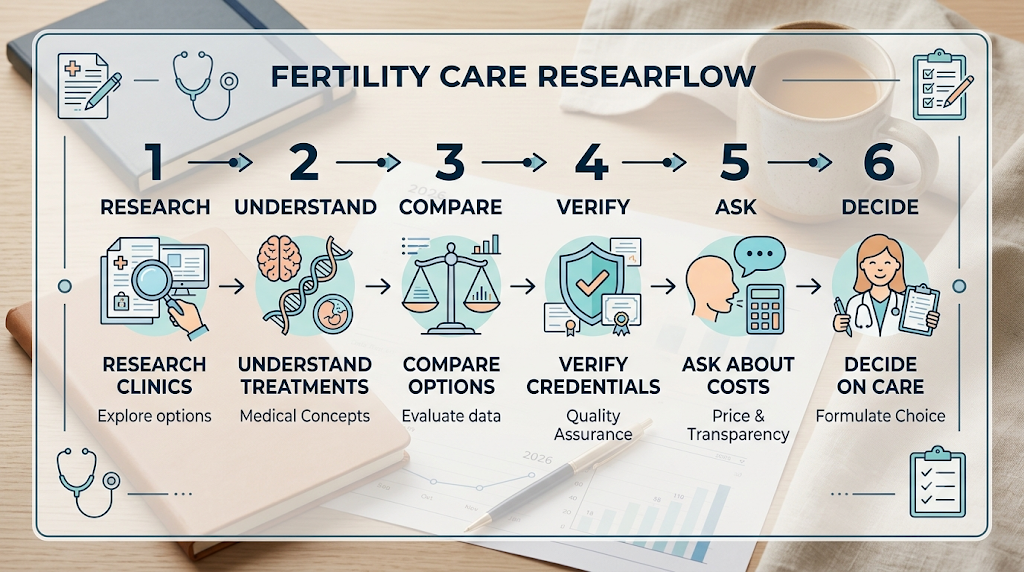
To keep your research organized, you can follow this six-step framework:
Research → Understand → Compare → Verify → Ask → Decide
- Research: Gather foundational information about reproductive anatomy, diagnostic testing, and common clinical pathways.
- Understand: Learn the mechanisms, medical indications, and potential limitations of specific procedures.
- Compare: Review different provider structures, service models, and published transparency standards.
- Verify: Check physician credentials, laboratory accreditations, and regulatory compliance records.
- Ask: Prepare a written list of questions regarding costs, protocols, and communication for your initial consultation.
- Decide: Select a healthcare provider based on medical expertise, personal comfort, and transparent practices.
Practical Provider Research Checklist
Keep this checklist handy when reviewing clinic websites or preparing for a medical consultation:
- [ ] Are the clinic’s doctors board-certified in reproductive endocrinology or related specialties?
- [ ] Is the embryology laboratory accredited by relevant health authorities, and is it on-site?
- [ ] Does the clinic provide a written, itemized cost breakdown explaining what is excluded from basic fees?
- [ ] How are cycle monitoring appointments scheduled, and can they accommodate your daily routine?
- [ ] Who will be your regular point of contact for daily medical questions and cycle updates?
- [ ] Does the clinic report its cycle outcomes to national regulatory registries?
- [ ] What are the clinic’s specific protocols for managing unexpected cycle cancellations or low responses?
- [ ] What options are available for cryopreservation and long-term storage?
Frequently Asked Questions
How should I compare IVF clinics?
To compare IVF clinics effectively, look at physician qualifications, laboratory accreditations, diagnostic capabilities, itemized cost transparency, communication practices, and compliance with national health regulations. Educational platforms like IVFHospitalsNow.com can help you identify these key criteria before attending consultations.
What factors affect IVF treatment cost?
Overall IVF treatment cost is influenced by required stimulation medications, pre-cycle diagnostic testing, embryology laboratory procedures (such as ICSI or genetic testing), anesthesia charges, and cryopreservation storage fees.
How should I interpret IVF success rates?
When reading IVF success rates, always look for data stratified by patient age, consider whether percentages reflect live births or positive pregnancy tests, and confirm that the numbers come from standardized, audited registries.
What should I consider before choosing IVF treatment abroad?
Before committing to IVF treatment abroad, examine the host country’s legal regulations regarding reproductive care, calculate total travel and accommodation expenses, ensure your medical records can be transferred, and establish a plan for follow-up care with a local doctor.
How can IVF cost by country be compared fairly?
To evaluate an IVF cost by country comparison fairly, you must add non-medical expenses—such as flights, lodging, daily living costs, currency conversions, and pre-travel local testing—to the clinic’s headline treatment quote.
What is the difference between ICSI vs IVF?
In the comparison between ICSI vs IVF, standard IVF allows fertilization to occur naturally in a laboratory dish containing eggs and multiple sperm. In ICSI, an embryologist injects a single selected sperm directly into an egg, which is often recommended for male-factor fertility challenges.
What factors affect egg freezing cost?
The total egg freezing cost includes initial ovarian reserve testing, stimulation medications, routine monitoring appointments, surgical retrieval, laboratory vitrification, and recurring annual storage fees.
Conclusion
Researching fertility care online requires balancing personal goals with objective information. Because reproductive medicine involves unique physical circumstances and detailed laboratory techniques, general internet research should serve as a starting point rather than a substitute for professional care. By focusing on verified provider credentials, understanding total expense breakdowns, and interpreting clinical data in context, you can navigate your options with confidence and work toward an informed decision alongside a qualified healthcare team.
Leave a Reply