From Robotics Development to RobotOps: Building Reliable Robot Operations at Scale
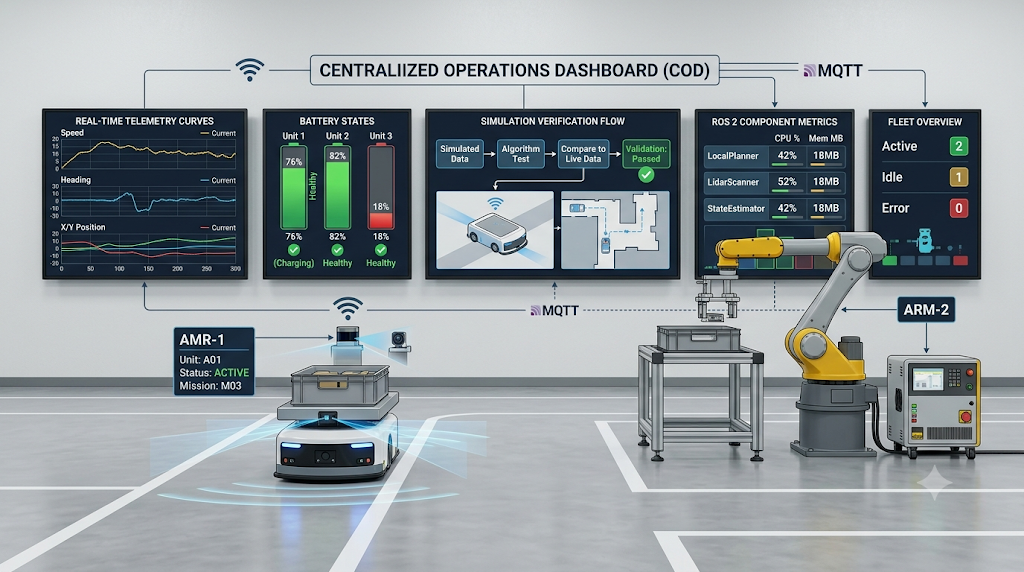
What Changes When Robotics Moves Into Production?
In a development lab, robotics engineering is contained. The testing arena is mapped down to the millimeter, ambient lighting is controlled, Wi-Fi access points are ten feet away, and fresh lithium-ion battery packs wait on charging benches. If an algorithm throws an unhandled exception or a drive motor stalls, an engineer simply steps in, attaches a physical debugging harness, reviews the terminal output, and recompiles.
The moment machines deploy into active customer environments, that controlled reality disappears.
Production robotics introduces variables that cannot be solved at the mechanical drawing board alone:
- Environmental friction: Ambient light shifts throughout the day, concrete floors produce unpredictable dust layers, and physical obstacles move without warning.
- Network instability: Facilities feature radio-opaque structural columns, high-density metal storage racks, and dead zones where wireless packets drop completely.
- Hardware wear: Wheel compounds degrade, drive belts stretch, camera lenses accumulate grime, and battery cells experience thermal stress over thousands of continuous discharge cycles.
- Fleet divergence: Without strict configuration enforcement, individual units quietly drift into mismatched software patches, parameter overrides, and uncalibrated sensor states.
When a single autonomous tug halts in an aisle, it is an inconvenience. When a silent configuration error cascades across forty machines in a fulfillment center during a peak shift, it is a catastrophic operational shutdown.
Operating machines in production demands continuous telemetry, proactive fleet management, reproducible simulation, controlled update delivery, and fast incident recovery. This operational discipline is the foundation of RobotOps.
What Is RobotOps?
RobotOps is the operational discipline of applying modern software engineering, DevOps, automation, observability, site reliability engineering (SRE), and lifecycle-management practices to physical robotic systems.
Traditional robotics engineering focuses on how to make a machine move, sense, and manipulate its environment. Software engineering determines how to build modular application code to drive those functions. RobotOps focuses on what happens across the rest of the machine’s multi-year deployment: how to monitor its internal states, push updates without risking physical damage, track mechanical degradation, and recover quickly when field incidents occur.
+-------------------------------------------------------------------------+
|                                RobotOps                                 |
|                                                                         |
|  Robotics Engineering    Software Engineering     Operational Lifecycle |
|  - Kinematics            - Modular Code           - Staged Deployments  |
|  - Sensor Integration    - Containerization       - Observability       |
|  - Motion Planning       - Automated Testing      - Incident Response   |
+-------------------------------------------------------------------------+
Rather than treating a robot as an isolated hardware device with embedded firmware, RobotOps treats it as a distributed edge compute platform with moving physical parts. It brings structure to everyday Robotics Operations, ensuring that deploying, running, and maintaining hundreds of machines becomes as repeatable and predictable as deploying cloud services.
Robot Fleet Management at Scale
Managing two or three machines in an open space can be handled with visual checks and manual terminal connections. Managing fifty, two hundred, or one thousand units across multiple geographic sites requires centralized Robot Fleet Management.
Fleet management software serves as the central orchestration and coordination layer for distributed machines. It provides real-time visibility into the operational state of every physical asset:
- Hardware health: Component fault codes, bus voltage levels, motor current draws, and onboard computer temperatures.
- Telemetry and state: Continuous streaming of localization confidence, travel velocities, subsystem latencies, and error logs.
- Energy lifecycle: Battery state-of-charge, internal cell temperatures, degradation rates, and automated charging station scheduling.
- Connectivity tracking: Real-time signal strength, dropped packet counts, and network latency per access zone.
- Spatial coordination: Multi-robot traffic routing, intersection management, and dynamic detour paths through shared bottlenecks.
- Version control: Active tracking of firmware builds, application container hashes, and parameter files across every unit.
| Fleet Requirement | Operational Need |
| Robot health | Continuous monitoring of internal subsystems, controllers, and sensors |
| Software versions | Version visibility to prevent configuration drift across units |
| Connectivity | Network monitoring with local caching during intermittent drops |
| Maintenance | Predictive and preventive processes based on operating hours and sensor data |
| Failures | Incident detection and automated triage before small faults escalate |
| Updates | Controlled software deployment with progressive staged rollouts |
When a fleet management system detects that an autonomous unit is operating with elevated drive motor temperatures, it can remove that machine from active dispatch, assign its pending transit order to an alternate unit, and route the affected machine to a maintenance bay for inspection.
Industrial Robotics Needs More Than Mechanical Engineering
In industrial settings, the physical presence of robotics is familiar. Multi-axis robotic arms perform spot welding, high-speed pick-and-place, precision machining, and automated quality inspection across manufacturing cells.
Historically, Industrial Robotics treated these systems as static equipment. Manipulator arms were programmed via handheld teach pendants, connected to local programmable logic controllers (PLCs), and left to execute fixed routines for years with minimal software updates.
Modern manufacturing requirements have upended this static model:
- Dynamic production runs: Assembly lines frequently change product variants, requiring rapid adjustments to toolpath trajectories and payload parameters.
- Sensor-driven feedback: High-resolution vision systems, force-torque sensors, and 3D profile scanners feed real-time perception data back into motion planning loops.
- Networked integration: Industrial controllers must communicate with plant-wide Manufacturing Execution Systems (MES) and Enterprise Resource Planning (ERP) databases.
Because of this connectivity, industrial manipulators require an operational software layer. Engineers must track toolpath scripts in centralized version control, monitor servo torque signatures to spot bearing wear before mechanical failure, and validate updated trajectories in simulation to prevent tooling from striking jigs or safety fences. The reliability of an industrial cell depends as much on disciplined software operations as it does on mechanical rigidity.
Robotics Software and the Modern Robot Stack
Modern Robotics Software is rarely structured as a single, monolithic binary running on bare metal. Instead, production machines run a layered, modular software stack designed to separate hardware abstraction from application logic.
+-------------------------------------------------------------------------+
|                  Application & Fleet Coordination Layer                 |
|       (Task Dispatch, Mission Planning, Fleet APIs, Cloud Sync)         |
+-------------------------------------------------------------------------+
                                    │
+-------------------------------------------------------------------------+
|                     Autonomy & Intelligence Layer                       |
|       (SLAM, Global/Local Path Planning, Obstacle Avoidance)            |
+-------------------------------------------------------------------------+
                                    │
+-------------------------------------------------------------------------+
|                       Perception & State Layer                          |
|         (Sensor Fusion, Point Cloud Filtering, State Estimation)        |
+-------------------------------------------------------------------------+
                                    │
+-------------------------------------------------------------------------+
|                   Middleware & Inter-Process Layer                      |
|             (Message Passing, Serialization, Node Lifecycles)           |
+-------------------------------------------------------------------------+
                                    │
+-------------------------------------------------------------------------+
|                      Hardware Abstraction Layer                         |
|         (Actuator Drivers, Bus Interfaces, Safety Controllers)          |
+-------------------------------------------------------------------------+
Each tier introduces distinct operational dependencies:
- Hardware Abstraction: Translates low-level serial, CAN bus, or EtherCAT communications into structured programmatic interfaces.
- Middleware Layer: Manages internal message passing, process discovery, and serialization between isolated programs.
- Perception and State: Ingests raw streams from lidars, depth cameras, and inertial measurement units (IMUs) to estimate machine state.
- Autonomy Stack: Calculates dynamic trajectories, evaluates obstacle clearance, and commands physical velocity vectors.
- Fleet Interface: Handles external APIs, telemetry aggregation, mission dispatch, and local map caching.
Because these layers depend on distinct libraries, runtime configurations, and hardware drivers, maintaining software consistency across a fleet requires modern containerization, immutable OS packaging, and rigorous dependency management.
Robot Simulation Before Real-World Deployment
Pushing untested code directly to production hardware carries unacceptable physical risks. A subtle coordinate-frame mismatch or an inverted sign in an avoidance routine can drive a multi-hundred-pound chassis into structural shelving or cause a high-payload industrial arm to impact a safety enclosure.
Robot Simulation serves as the automated safety gate in a mature operations pipeline. Simulation engines construct physics-based virtual environments that model kinematics, dynamics, gravity, contact mechanics, and realistic sensor noise.
Design ──> Simulate ──> Test ──> Validate ──> Deploy ──> Monitor ──> Improve
Within an automated continuous integration (CI) workflow, simulation provides:
- Path-planning regression checks: Verifying that a new navigation algorithm navigates narrow corridors without timing out.
- Failure mode reproduction: Replaying sensor recordings from field incidents inside a virtual replica to diagnose edge-case bugs.
- Edge-case stress testing: Subjecting virtual machines to simulated wheel slippage, sensor dropouts, or degraded lighting without physical risk.
- Fleet-scale scenario modeling: Validating how dozens of simulated agents navigate shared intersections before releasing new dispatch logic.
While simulation drastically lowers operational risk, it does not replace physical testing. Virtual models cannot fully duplicate subtle mechanical backlash, floor traction variations, or unexpected optical reflections. Simulation serves to filter out logic errors and regressions early, leaving physical staging units to validate real-world edge cases.
Autonomous Mobile Robots and Fleet Operations
Autonomous Mobile Robots (AMRs) represent one of the fastest-growing sectors of modern automation. Unlike Automated Guided Vehicles (AGVs) that follow magnetic floor tape or embedded wires, AMRs navigate dynamically using onboard sensors, point clouds, and localization algorithms.
AMRs operate in human-shared, unpredictable environments: logistics hubs, cross-docking terminals, manufacturing plants, and healthcare facilities. Their dynamic nature creates specific operational requirements:
- Dynamic path planning: AMRs must safely navigate around moving forklifts, fallen cartons, and human pedestrians while maintaining operational pace.
- Map lifecycle management: When facility layouts shift—such as when storage aisles are reconfigured—updated environmental maps must be distributed to all units simultaneously without desynchronizing active localization.
- Battery lifecycle balancing: Fleet dispatchers must balance charging states so that high-priority missions are assigned only to machines with sufficient runtime, preventing stranded units in active transit aisles.
- Wireless roaming: As mobile units traverse large facilities, software must manage Wi-Fi handoffs between access points gracefully, buffering operational telemetry locally whenever connectivity drops.
As an AMR fleet scales from ten to two hundred units, manual recovery of stopped units becomes unsustainable. Operations teams rely on automated telemetry to immediately distinguish between a path blocked by temporary debris and a machine stopped by a failing inertial measurement unit.
Robotics Automation and Operational Efficiency
The term Robotics Automation is often used to describe deploying a robot to complete a manual physical task, such as palletizing cartons, tending machine tools, or transporting materials.
In an operational context, however, there is a fundamental distinction between:
- Automating the physical task: Programming a robotic system to lift, weld, navigate, or inspect items.
- Automating the operational infrastructure: Building the software pipelines that provision, configure, test, update, monitor, and recover the machines performing those tasks.
Automating the machine solves the labor requirement of the physical task. Automating the operational infrastructure makes running the machine cost-effective at scale.
If an engineering team must manually SSH into each machine to deploy updates, inspect logs, or restart crashed services, the operational overhead grows linearly with every robot added. By automating system provisioning, pre-shift self-tests, telemetry aggregation, and deployment rollbacks, organizations ensure that a lean engineering team can reliably operate an expanding fleet.
The Robotics Operations Center
As deployments mature, organizations centralize their operational visibility through a Robotics Operations Center (ROC).
A ROC is not necessarily a high-cost physical control room with floor-to-ceiling displays. For most engineering organizations, it is a unified software platform that consolidates telemetry, system health, deployment pipelines, and remote diagnostics into a coherent interface.
+-------------------------------------------------------------+
|                     Physical Layer                          |
|    [ Robot 1 ]         [ Robot 2 ]         [ Robot N ]      |
+-------------------------------------------------------------+
                              │
                              ▼ (Secure Wireless / MQTT / DDS)
+-------------------------------------------------------------+
|                   Connectivity Layer                        |
|       Local Access Points, Edge Gateways, VPN Tunnels       |
+-------------------------------------------------------------+
                              │
                              ▼
+-------------------------------------------------------------+
|                Fleet Infrastructure Layer                   |
|     Message Ingestion, Time-Series Databases, Log Storage   |
+-------------------------------------------------------------+
                              │
                              ▼
+-------------------------------------------------------------+
|                 Robotics Operations Center                  |
|     Dashboards, Alert Routers, Remote Diagnostic Consoles   |
+-------------------------------------------------------------+
                              │
                              ▼
+-------------------------------------------------------------+
|                    Human Operations                         |
|             Operators, Support Engineers, SREs              |
+-------------------------------------------------------------+
1. Physical Layer
The mobile units, arms, sensors, and microcontrollers operating in production facilities.
2. Connectivity Layer
Local networking infrastructure, industrial Wi-Fi access points, cellular gateways, and secure cryptographic tunnels that connect machines to servers.
3. Fleet Infrastructure Layer
Scalable backend services responsible for ingesting high-throughput telemetry, persisting runtime logs, processing error queues, and managing mission dispatch.
4. Robotics Operations Center
The visualization and management plane. It provides fleet availability heat maps, battery status breakdowns, live alert feeds, and secure, auditable tools for running remote diagnostics.
5. Human Operations
Support engineers and technicians who monitor high-level fleet health, respond to actionable alerts, review diagnostic sensor dumps, and coordinate field maintenance.
ROS 2 and Production Robotics
The Robot Operating System (ROS) has served as the foundation of academic and prototype robotics for years. However, its successor, ROS 2, was architected specifically to support commercial, multi-robot, and production environments.
ROS 2 replaces custom communication transports with industry-standard Data Distribution Service (DDS) middleware. This provides real-time publish-subscribe messaging, hardware-level Quality of Service (QoS) profiles, and support for real-time operating systems (RTOS).
Core building blocks include:
- Nodes: Modular, isolated processes responsible for single tasks (e.g., motor drive control, lidar driver, localization).
- Topics: Publish-subscribe data buses used for streaming continuous sensor and state data.
- Services: Synchronous request-response mechanisms for discrete transactions.
- Actions: Non-blocking, goal-oriented communication for long-running behaviors (e.g., navigating to a charging dock with continuous progress feedback).
- Middleware (DDS): The underlying transport layer handling node discovery, serialization, and network routing.
However, writing clean ROS 2 nodes does not automatically solve operational challenges. A running ROS 2 application still needs an operational scaffolding:
- Lifecycle Management: Using managed node lifecycles (
unconfigured,inactive,active,finalized) to ensure sensor drivers and motion controllers initialize in strict, safe sequences. - DDS Domain Isolation: Configuring unique ROS domain IDs and DDS partitions to prevent machines on the same facility subnet from cross-talking.
- Resource Monitoring: Tracking CPU, memory, and thread utilization across individual ROS 2 nodes to catch memory leaks before processes terminate unexpectedly.
Observability for Robotic Systems
Traditional IT monitoring typically answers binary questions: Is the web server running? Is port 443 accepting traffic?
In robotics, a machine can be fully powered on, connected to the local network, and passing health checks, yet entirely incapable of operating safely. Its localization confidence may have collapsed, an optical sensor may be blinded by direct sunlight, or an actuator gearbox may be binding under load. Observability in robotics requires analyzing multiple distinct data streams:
Logs
Structured text records detailing internal events. To be useful in fleet operations, logs must be categorized by severity, tagged with consistent robot identifiers, and structured (e.g., JSON) so central aggregators can parse exceptions without manual intervention.
Metrics
Time-series numeric values that quantify machine state. These include compute resources (CPU, RAM, disk space), hardware indicators (bus voltages, motor current draws, joint temperatures), and operational progress (mission completion rates, localization error margins, path calculation latencies).
Telemetry
The continuous stream of lightweight operational data sent from the robot to central servers. Telemetry provides the real-time heartbeat of the machine, including position coordinates, velocity, battery discharge rate, and active subsystem states.
Alerts
Automated triggers that notify operations personnel when metrics breach defined safety or performance thresholds. Alerts must be strictly tuned to be actionable; routing alerts for temporary, self-correcting network drops creates alert fatigue, causing operators to overlook critical hardware failures.
Event Tracking
Immutable records of operational milestones: mission dispatches, emergency-stop actuations, charging dock connections, and parameter adjustments. Event tracking provides the chronological context needed to diagnose why an incident occurred.
Software Deployment and Robot Lifecycle Management
Deploying software to a fleet of physical robots involves risks that cloud deployments never face. If a cloud server encounters a faulty update, the traffic router directs requests to healthy containers while the failing instance is discarded. If a faulty update deploys to a fleet of autonomous mobile robots, physical machines can stop mid-transit, block facility traffic, or execute unintended motion commands.
Managing the software lifecycle across a fleet requires controlled, staged deployment pipelines:
[ Build & Test ] ──> [ Simulation Check ] ──> [ Staging Validation ]
                                                      │
                                                      ▼
[ Post-Rollout Monitoring ] <── [ Broad Rollout ] <── [ Canary Group (5%) ]
            │
            └──(Error Threshold Exceeded)──> [ Automated Safe Rollback ]
- Immutable Artifacts: Software stacks should be compiled into reproducible, immutable container images or signed OS packages. Manual shell patching on individual units leads directly to configuration drift.
- Canary Deployments: Updates should deploy to a small, isolated test cohort (e.g., 5% of the fleet) operating in low-risk zones.
- Automated Health Gates: The deployment pipeline monitors telemetry and error rates on the canary units. If localization faults or node crashes exceed historical thresholds, the update halts immediately.
- Automated Rollback: If a deployed update fails in the field, machines must automatically revert to the previous verified software image without requiring manual physical intervention.
- Retirement and Decommissioning: When hardware reaches end-of-life, operational processes ensure security certificates are revoked, local storage is sanitized, and assets are cleanly removed from fleet directories.
Reliability and Incident Management
Operational failures in physical robotics are inevitable. Actuators degrade, sensors drift out of calibration, facility lighting changes, and network infrastructure experiences local outages.
High-reliability operations rely on a disciplined incident response cycle:
Detect ──> Diagnose ──> Respond ──> Recover ──> Learn
- Detect: Automated observability tools spot anomalies—such as an AMR experiencing repeated path-planning timeouts—and raise an incident ticket.
- Diagnose: Support engineers inspect telemetry curves, node execution logs, and short diagnostic sensor recordings (such as ROS bag snapshots) captured immediately prior to the failure.
- Respond: The operations team executes an immediate containment action: pausing the affected unit, isolating it from active task queues, or assigning a remote operator to evaluate physical surroundings.
- Recover: The machine is returned to a safe operational state, whether by triggering a safe software restart, rolling back a configuration file, or dispatching an on-site technician for manual relocation.
- Learn: The engineering team conducts a blameless root-cause analysis (RCA), documents the environmental or software edge case, and adds a regression test to the automated simulation suite to prevent recurrence.
A Practical RobotOps Lifecycle
The RobotOps framework connects every phase of a robot’s existence into an integrated, repeatable lifecycle:
| Stage | Key Activities |
| Develop | Build modular software nodes, interfaces, and drivers using established frameworks |
| Simulate | Run virtual scenario suites to validate algorithms and catch motion regressions |
| Validate | Verify performance, safety circuits, and sensor baselines on physical staging units |
| Deploy | Deliver immutable software and configuration packages using staged canary rollouts |
| Observe | Ingest real-time telemetry, structured logs, and time-series hardware metrics |
| Operate | Manage active task dispatches, traffic routing, and charging infrastructure |
| Maintain | Execute preventive component replacements and automated calibration routines |
| Improve | Analyze incident trends and sensor logs to refine both software and mechanical designs |
Common RobotOps Challenges
Organizations scaling robotic systems frequently encounter several predictable operational friction points:
- Heterogeneous Fleets: Facilities rarely run identical machines. Managing different robot types—each running distinct operating systems, sensor payloads, and compute boards—complicates deployment and monitoring. Standardizing on common container platforms and unified telemetry protocols mitigates this fragmentation.
- Intermittent Connectivity: Mobile machines frequently lose signal behind concrete pillars or within metal storage bays. Systems must be engineered with local caching and offline autonomy, allowing units to complete assigned tasks safely without active server connections.
- Bandwidth Saturation: Streaming raw camera feeds and high-density point clouds across a facility Wi-Fi network quickly exhausts bandwidth. Teams must process sensor data on the edge and transmit only aggregated health metrics and event-driven telemetry over the air.
- Simulation-to-Reality Gaps: Algorithms that perform cleanly in virtual environments often stumble against real-world floor debris, ambient sunlight glare, and tire wear. Maintaining a small physical testing area alongside virtual simulation remains essential.
- Alert Fatigue: Setting overly sensitive monitoring thresholds causes operators to drown in non-actionable notifications. Alerts must be refined to fire only when an issue demands concrete human intervention.
How to Build a RobotOps Strategy
Transitioning to an operational mindset requires a structured, step-by-step roadmap:
Step 1: Understand the Fleet
Document every robot variant, onboard compute architecture, operating system, sensor suite, power requirement, and physical operating environment.
Step 2: Standardize Software
Eliminate manual, ad-hoc terminal changes in the field. Package applications into immutable containers, manage configuration files in version control, and tag release builds consistently.
Step 3: Establish Observability
Implement lightweight telemetry agents that stream critical host metrics (CPU, memory, disk, network) and robotics vitals (battery health, localization confidence, node status) to a central dashboard.
Step 4: Automate Repetitive Operations
Script standard operational routines: automated OS provisioning, pre-mission self-diagnostic checks, and automated log collection during safety events.
Step 5: Create Incident Workflows
Establish clear, documented protocols for incident detection, operational containment, diagnostic sensor dumping, remote triage, and field escalations.
Step 6: Use Simulation in CI/CD
Integrate physics-accurate virtual testing into the development pipeline so that pull requests are automatically evaluated against navigation and edge-case scenarios before merging.
Step 7: Develop Internal Skills
Foster cross-functional expertise within engineering teams, bridging traditional robotics development with modern cloud, DevOps, SRE, and systems administration practices.
Evaluating a RobotOps Technology Approach
When architecting or evaluating tools to support robotics operations, engineering leaders should review systems against practical operational requirements:
- [ ] Fleet Scalability: Can the platform ingest telemetry and manage states for hundreds of concurrent units without latency degradation?
- [ ] Heterogeneous Support: Does the tooling support multiple hardware platforms, compute boards, and sensor configurations?
- [ ] Network Resilience: Can edge agents store logs and telemetry locally during network outages and sync reliably upon reconnection?
- [ ] Deployment Safety: Does the system support progressive canary deployments, automated health gates, and instant rollbacks?
- [ ] Security Architecture: Are all communications encrypted, device identities backed by hardware certificates, and user roles controlled via granular RBAC?
- [ ] Observability Depth: Does the platform capture real-time telemetry alongside structured logs and on-demand sensor recordings?
- [ ] Workflow Extensibility: Can the operational platform integrate with existing enterprise ticketing, CI/CD, and inventory management systems via standard APIs?
About RobotsOps.com
For engineers, developers, and technical leaders seeking to deepen their practical knowledge of robotics operations, RobotsOps.com serves as an educational and technical knowledge platform dedicated to the RobotOps discipline.
The site provides practical resources covering the complete operational lifecycle of modern robotic systems. Readers can explore detailed guides on Robot Fleet Management, centralized monitoring, telemetry collection, predictive maintenance, and incident management. The platform features in-depth material on Industrial Robotics—including robotic arms, controllers, sensors, and factory safety—alongside technical architectures for Robotics Software, middleware, and perception systems.
Through practical guides on Robot Simulation, learners can examine how virtual testbeds help teams validate code safely before deployment. The platform covers the real-world operational demands of Autonomous Mobile Robots, modern Robotics Automation across logistics and manufacturing, and the centralized architecture of the Robotics Operations Center. With educational tutorials spanning ROS 2, telemetry infrastructure, and reliable deployment practices, the platform provides actionable knowledge for building, monitoring, and scaling robotic systems in production.
Conclusion
Developing capable robotics software and precision mechanical hardware is an impressive engineering achievement. However, building an advanced prototype is only the beginning of the engineering journey.
In active production environments, the ultimate success of an automated deployment depends on operational discipline. Reliable operations require robust observability into internal system states, physics-based simulation pipelines, staged software deployments, automated health monitoring, and structured incident response workflows. By bridging the gap between robotics engineering and operational practice, RobotOps provides the tools and processes necessary to keep physical fleets running safely, reliably, and efficiently at scale.
Leave a Reply