Research, Evaluate, and Select the Right Digital Tools for Your Team
Introduction
Finding reliable digital products has become one of the most deceptively complex challenges facing teams and independent operators. At a glance, modern platforms within the same category often look almost identical. Landing pages present sleek interfaces, clean dashboards, and promising lists of capabilities. Beneath that polished surface, however, solutions can differ drastically in their pricing models, integration depth, infrastructure requirements, user permissions, and data privacy policies.
Relying purely on marketing claims, sponsored placements, or vendor popularity frequently leads to buyer remorse. A platform might have tremendous momentum online, yet completely fail to satisfy your specific technical stack or security standards. Making sensible technology investments requires shifting away from superficial impressions toward a structured, evidence-based research methodology.
Start by Outlining Real Operational Requirements
Before browsing product pages or signing up for trials, take time to write down your actual operational needs. When buyers skip this initial stage, they easily fall into the trap of letting external feature sets dictate their operational priorities, rather than looking for an application that solves an existing operational challenge.
A well-rounded requirements checklist should cover several critical dimensions:
- The Primary Problem: What specific operational bottleneck, manual inefficiency, or technical limitation are you attempting to resolve?
- Essential Capabilities: Which functions are strictly non-negotiable for everyday work, and which items are simply secondary preferences?
- User Profiles and Scale: Who will actually interact with the system on a daily basis? How many active seats, administrators, and external collaborators are needed?
- Integration Ecosystem: Which databases, communication suites, cloud providers, or analytics platforms must the new solution communicate with immediately?
- Budgetary Framework: What is the realistic ceiling for recurring subscriptions, implementation costs, seat expansion, and maintenance?
- Security and Compliance: Does your team need to comply with specific data sovereignty regulations, data retention policies, or single sign-on standards?
- Deployment Preferences: Does the system need to run as multi-tenant SaaS, within a dedicated private cloud, or entirely on self-managed infrastructure?
Having these parameters clearly documented on paper serves as an objective filter throughout the entire search process.
Discover Promising Market Alternatives
Once you establish internal boundaries, begin compiling an initial roster of candidate solutions. Jumping directly into generic search queries often surfaces only the brands with the largest advertising budgets, potentially overlooking leaner, more specialized utilities tailored to your operational scale.
A comprehensive discovery phase uses diverse reference points:
- Structured Catalogs: Browsing a focused software directory allows you to discover options mapped cleanly by subcategory, deployment model, and primary functional focus.
- Technical Documentation: Looking directly at public API references, administrative manuals, and support forums reveals how a system works under realistic operating conditions.
- Peer Communities: Developer forums, operational discussion boards, and open-source communities provide straightforward observations regarding reliability, edge cases, and ongoing maintenance demands.
- Category Overviews: Industry analysis reports and organized overview matrices help categorize tools based on architectural complexity rather than brand recognition.
Building a wide initial pool guarantees that you do not prematurely anchor your evaluation to one prominent vendor before knowing what alternatives exist.
Focus on Substantive Operational Criteria
Feature quantity is rarely an accurate proxy for software quality. A platform boasting hundreds of niche functions can easily prove frustrating if its fundamental workflows are clunky, slow, or poorly documented.
When conducting a hands-on software comparison, direct your attention toward structural fundamentals:
- Workflow Usability: Can end users execute their most repetitive tasks without excessive friction, confusing navigation, or deep administrative intervention?
- API Extensibility: Are public endpoints robust, properly documented, and maintained with sensible rate limits and webhooks?
- Administrative Governance: Can managers configure granular, role-based access controls, monitor user activity via audit logs, and automate onboarding?
- Documentation Depth: Does the vendor provide clear troubleshooting guides, configuration examples, and active change logs, or are resources sparse and dated?
- Licensing Transparency: Are core features gated behind high enterprise tiers, or are functional boundaries fair and predictable as usage grows?
By weighing these operational realities above novelty features, you protect your team from adopting software that requires constant workarounds.
Examine Evaluative Evidence with Care
User testimonials and rating summaries can provide valuable context, but they should never be accepted without scrutiny. Many public rating platforms aggregate feedback without vetting whether the reviewer operates in an environment comparable to your own.
When parsing software reviews, evaluate the underlying context:
- Reviewer Environment: A tool that receives high marks from a five-person creative agency might utterly fail to meet the data compliance or concurrency demands of an enterprise engineering team.
- Analytical Methodology: Look for independent software reviews that clearly outline the testing environment, operational conditions, and documented constraints rather than vague praise or emotional critiques.
- Recency of Feedback: Digital products undergo rapid changes in their pricing, user experience, and architecture. Insights older than twelve to eighteen months may reference resolved limitations or obsolete subscription tiers.
- Concrete Failure Modes: Pay closest attention to specific observations regarding performance bottlenecks, integration reliability, and support responsiveness, rather than broad statements about customer satisfaction.
Treat feedback as qualitative input to guide your own testing, rather than definitive proof of a system’s viability.
Navigating Modern Machine Learning and Intelligent Systems
Evaluating applications that incorporate machine learning models introduces variables that traditional functional checklists do not capture. Because these models generate probabilistic outputs, assessing their suitability requires examining data governance, operational consistency, and real computational costs.
When exploring an AI tools directory, avoid vague generalities and investigate foundational operational mechanics:
- Task Alignment: Determine whether the tool employs dedicated, purpose-built models suited for your domain, or merely provides a thin wrapper around generic base models.
- Data Handling and Privacy: Confirm whether your proprietary inputs and user data are retained, stored securely, or utilized to train third-party machine learning models.
- System Extensibility: If the tool will operate within automated pipelines, examine API latency, serialization support, and integration points with existing infrastructure.
- Cost Predictability: Review token metering, compute quotas, and seat charges to understand how expenses scale as your input volumes expand.
Rather than trying to identify universal best AI tools, take the time to methodically compare AI tools against your own data schemas, throughput targets, and compliance requirements.
Practical Considerations for Workplace Applications
Department-wide platforms, such as customer relation databases, enterprise resource planning suites, and project management portals, carry substantial organizational inertia. Switching systems disrupts daily productivity, making initial alignment vital.
A structured business software comparison must account for real human workflows:
- Implementation Effort: What does historical data migration, field mapping, and user provisioning look like in practice? Does the vendor demand dedicated onboarding consultants?
- Operational Friction: Does the application naturally mirror the handoffs between teams, or does it force departments to adapt their working styles to rigid software schemas?
- Security Posture: Does the platform accommodate existing identity providers (IdP), multi-factor authentication policies, and single sign-on (SSO) protocols without punitive tier upgrades?
- Long-Term Maintainability: Will managing this tool require a full-time internal administrator, or can routine maintenance be distributed across department leads?
A system that handles core processes smoothly will always yield higher long-term utility than an overly complicated alternative that employees actively avoid using.
Establish a Step-by-Step Shortlist Workflow
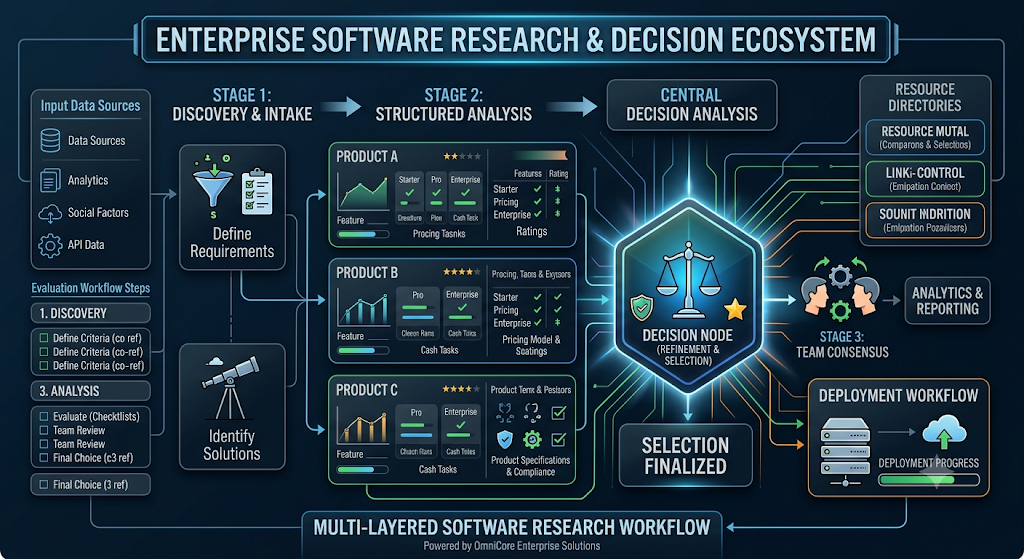
To prevent research from stalling into endless exploration, follow a disciplined evaluation funnel that moves logically from broad scanning to definitive action:
- Define the Problem: Write down your team’s exact challenge, core objectives, and operating constraints.
- Identify Must-Have Requirements: Separate non-negotiable features, compliance standards, and integration needs from minor preferences.
- Discover Potential Products: Survey the market broadly using documentation, technical articles, and directories to assemble candidate solutions.
- Filter Unsuitable Options: Immediately eliminate tools that fail your budget caps, compliance requirements, or core technical baselines.
- Compare Shortlisted Tools: Evaluate the remaining three to five platforms side by side against usability, architectural integrity, and administrative controls.
- Review Available Evidence: Consult technical documentation and independent feedback to uncover undocumented edge cases.
- Verify Important Information: Check current vendor resources to verify pricing, tier restrictions, and integration availability directly.
- Test Where Practical: Run a small, structured trial involving real operational data and representative end users.
- Select the Right Fit: Choose the application that addresses your operational challenges cleanly and reliably.
Following this sequence ensures that when you identify the best software tools for your unique requirements, your decision rests on reproducible facts rather than marketing narratives.
Verify Critical Operational Details Directly
Digital service providers frequently revise their pricing structures, usage caps, licensing restrictions, and feature allocations across tiers. Information cited in third-party articles, forum discussions, or older documentation can quickly become outdated.
Prior to entering into contracts or committing significant organizational resources, verify fundamental operational variables:
- Confirm that needed third-party integrations are actively maintained and included in your selected subscription tier.
- Review data egress policies, backup routines, and standard export formats to confirm that your data remains portable.
- Clarify user license definitions to ensure read-only seats, guest collaborators, and administrative accounts do not trigger unanticipated invoices.
Taking a few minutes to confirm these practical details with direct vendor documentation avoids costly surprises after deployment.
Research Resources on BestAIToolix.com
Platforms dedicated to structured technology discovery help streamline the early phases of software evaluation. BestAIToolix.com serves as an evidence-driven software discovery, research, and comparison platform built to assist technical teams, business operators, and technology buyers in making informed technology decisions.
On BestAIToolix.com, users can explore structured product profiles, transparent methodology documentation, and detailed comparative resources across diverse fields such as cloud infrastructure, DevOps, cybersecurity, observability, databases, and emerging intelligent platforms. Whether you are consulting a practical software buying guide to establish internal procurement criteria or browsing technical category overviews, having access to structured product data helps simplify the research process.
Frequently Asked Questions
How should a team balance feature count against platform simplicity?
Prioritize workflow efficiency and user adoption over an extensive list of minor capabilities. Software that performs core tasks reliably with minimal cognitive friction consistently outperforms complex systems filled with secondary functions that teams rarely use.
When is running a hands-on pilot or trial truly necessary?
A practical pilot is critical whenever a tool must integrate directly into sensitive data pipelines, support high concurrent user loads, or serve as the daily operational hub for multiple departments. Hands-on testing surfaces real-world usability friction, latency, and integration limits that cannot be identified from static product specifications.
How can buyers minimize the risk of vendor lock-in?
Prioritize platforms that support open, non-proprietary data formats, provide comprehensive REST or GraphQL APIs, and offer documented, fee-free data export mechanisms. Ensuring your operational records remain easily portable protects your organization if pricing or service terms change down the road.
What is the best way to handle software pricing that scales with usage?
Calculate total ownership costs by mapping your projected growth across every billable metric, including active seats, API calls, compute cycles, and storage volume. Establishing internal usage monitors and selecting vendors with transparent billing caps helps prevent unexpected monthly expenses.
Conclusion
Selecting software for modern organizations demands patience, discipline, and an evidence-based perspective. By starting with documented requirements, exploring market alternatives beyond paid advertisements, evaluating platforms on deep architectural criteria, and verifying critical specifications directly, technology buyers can navigate complex software markets with clarity. Independent research hubs like BestAIToolix.com provide structured information to aid this discovery process, helping teams select systems that foster genuine productivity, technical resilience, and operational stability over the long term.
Leave a Reply