The Education Search in India: How to Evaluate Tutors, Coaching Centers, and Universities
Introduction
Academic milestones in India routinely present families with difficult choices. A student transitioning into secondary school may struggle with complex algebra concepts, an eleventh grader might need structured coaching for national entrance tests, and a high school graduate is often tasked with selecting an undergraduate degree from dozens of competing universities.
The fundamental challenge is rarely an absence of options; rather, it is how fragmented those options are. Critical details regarding qualified teachers, local coaching centers, university accreditations, and national test schedules are scattered across different websites, community noticeboards, and unverified social media discussions. Relying on casual hearsay or aggressive promotional advertisements can lead to mismatched expectations, wasted financial resources, and unnecessary stress.
Making sound academic choices requires a methodical research approach. By breaking the planning process into distinct, manageable stages—individual tutoring, institutional coaching, higher education discovery, and competitive examinations—students and parents can build an educational path tailored to their personal strengths, budgets, and long-term goals.
Finding the Right Tutor
Private tutoring provides personalized instructional support, helping students address specific conceptual hurdles that regular classroom environments may not fully resolve.
With the growth of digital classrooms, learners are no longer limited to instructors available within their immediate neighborhood. When families decide to find tutors online, the objective is usually to fix a targeted academic weakness: clarifying complex chemistry reactions, mastering advanced calculus proofs, or strengthening reading comprehension for language evaluations.
Evaluating a virtual tutor requires reviewing practical instructional factors rather than surface credentials:
- Syllabus and board alignment: Pedagogical needs differ across curricula. A tutor experienced with state board patterns may not be familiar with the analytical question formats required by CBSE, CISCE, Cambridge (IGCSE), or International Baccalaureate (IB) assessments. Ensure the teacher has direct experience with your target syllabus.
- Instructional style and pacing: Some students need visual demonstrations and patient foundational rebuilding, while others benefit from fast-paced problem sets and past-paper drills. An introductory discussion or diagnostic session is essential to observe how the educator communicates with the learner.
- Feedback and assessment routines: Regular progress checks are necessary for continuous improvement. Inquire about how often assessments are conducted, whether lesson summaries are shared, and how the tutor answers doubts that arise between scheduled classes.
Connecting with specialized online tutors India allows families to access experienced subject educators nationwide, eliminating travel fatigue while maintaining high instructional standards.
At the same time, in-person instruction remains a vital format. Younger children, students needing physical routine, or those working on practical, laboratory-focused subjects often perform better when an instructor is physically present in the room.
When searching to find tutors near me, physical location is the starting point, but proximity alone should not decide the matter. Check whether the educator offers one-on-one sessions or micro-batches of three to five students, and verify whether they conduct an initial assessment to identify foundational gaps before starting standard syllabus lessons.
Researching Coaching Institutes
Structured coaching centers play a substantial role in Indian education, particularly for board examinations and national entrance evaluations. However, the sheer density of centers across cities makes selecting the right academy a demanding task.
Searching for coaching institutes near me typically reveals a wide mix of neighborhood tuition academies and regional branches of large coaching networks. To look past marketing campaigns and promotional claims, parents and students should evaluate centers using objective operational factors:
- Faculty continuity: Promotional brochures often showcase prominent senior faculty, but daily classroom delivery may be assigned to junior or newly recruited instructors. Always clarify which teachers will be assigned to your student’s specific batch.
- Doubt-resolution frameworks: The true quality of an institute often shows after lectures conclude. Does the center offer dedicated doubt-clearing desks? Are faculty members or teaching assistants accessible during self-study hours?
- Testing cadence and diagnostic reporting: Consistent practice is critical, but mock tests must deliver actionable feedback. Reliable institutes provide reports that highlight chapter-level weaknesses, time spent per section, and recurring error types.
For students considering relocation to major academic hubs, researching what many consider the best coaching institutes in India means looking beyond top rank lists. The right center is not necessarily the largest or most publicized; it is the institute whose teaching pace, batch size, and internal culture match the student’s individual learning style and academic temperament.
Searching for Colleges and Courses
Choosing where to pursue higher education is one of the most significant investments a family makes. Yet, high school graduates frequently build college shortlists based on unverified opinions or broad institutional reputations.
Conducting a thorough college search India requires looking past promotional campus brochures and examining tangible institutional foundations:
- Statutory approvals and accreditations: Confirm whether the institution and its specific degree programs are recognized by relevant authorities such as the UGC, AICTE, or NAAC.
- Faculty background and lab infrastructure: A modern curriculum requires qualified educators and accessible laboratories, libraries, and digital research tools, particularly in technical, medical, design, and management disciplines.
- Realistic employment outcomes: Review median placement figures rather than isolated top salary packages, which can present a misleading picture of overall student outcomes.
It is equally important to systematically compare colleges and courses side by side. A student weighing a specialized degree against a broader foundational program must consider multiple trade-offs: total tuition and living costs, syllabus flexibility, elective choices, campus location, and postgraduate pathways. Evaluating these elements objectively removes emotional bias and leads to more confident decisions.
Understanding Competitive Exams
Competitive entrance assessments serve as the gateway to professional higher education across engineering, medicine, management, law, design, defense, and central universities. Each evaluation operates with its own qualifying criteria, syllabus scope, and testing dynamics.
Navigating the landscape of competitive exams in India requires understanding how different entrance assessments are structured:
- Engineering: National tests like JEE Main and JEE Advanced, alongside state-level CETs and private university assessments, evaluating analytical physics, advanced mathematics, and conceptual chemistry.
- Medicine: NEET-UG for undergraduate medical, dental, and allied healthcare admissions, focusing on detailed biological concepts and applied physical sciences.
- Law & Central Universities: CLAT and AILET for national law universities, and the Common University Entrance Test (CUET) for admissions across central, state, and participating private universities.
- Design & Architecture: Evaluations like NID DAT, NIFT, and NATA, assessing spatial visualization, lateral problem-solving, and creative perception.
Understanding the specific nature of an examination prevents wasted preparation time. An exam that emphasizes speed and accuracy under tight time constraints demands very different pacing strategies than an exam focused on multi-concept synthesis.
Planning Competitive Exam Preparation
Performing well in national entrance assessments requires disciplined daily execution rather than frantic last-minute cramming. High-volume memorization rarely holds up against analytical, concept-driven question papers.
A structured competitive exam preparation plan relies on three fundamental practices:
- Syllabus modularization: Divide the official syllabus into high-priority, moderate-priority, and foundational topics. Focus first on core concepts that serve as building blocks for multiple chapters.
- Active problem solving: Rereading notes can create a false sense of mastery. True retention comes from solving problems without assistance, followed by maintaining an error journal to track conceptual mistakes, misread questions, and calculation errors.
- Timed mock simulations: Taking full-length mock tests under authentic exam conditions builds cognitive stamina, improves time allocation across sections, and teaches students when to skip time-consuming questions.
Tracking measurable progress over time helps students stay focused, minimize stress, and make informed adjustments to their study schedules based on evidence.
Competitive Exams After 12th
The transition after Class 12 is a pivotal moment for Indian students. The growth of unified testing frameworks like CUET, alongside established technical assessments, has made professional pathways more accessible across diverse fields.
Researching competitive exams after 12th early in high school helps students understand the wide range of available career options:
- Integrated Law (BA/BBA LLB): National Law Universities select candidates via CLAT and AILET, testing reading comprehension, logical reasoning, and general awareness.
- Creative and Design Fields: Entrance tests for NID, NIFT, and architecture programs evaluate observational skills, visual thinking, and design aptitude.
- Commerce, Humanities, and Sciences: Standardized national entrance tests allow students to compete for top degree colleges across the country through a transparent testing framework.
- Armed Forces: The National Defence Academy (NDA) examination offers an immediate pathway into military leadership, combining written academic tests with comprehensive physical and personality assessments.
Staying informed about eligibility requirements, reservation policies, registration schedules, and counseling processes ensures that students do not miss important administrative deadlines.
How GurukulGalaxy Supports Education Discovery
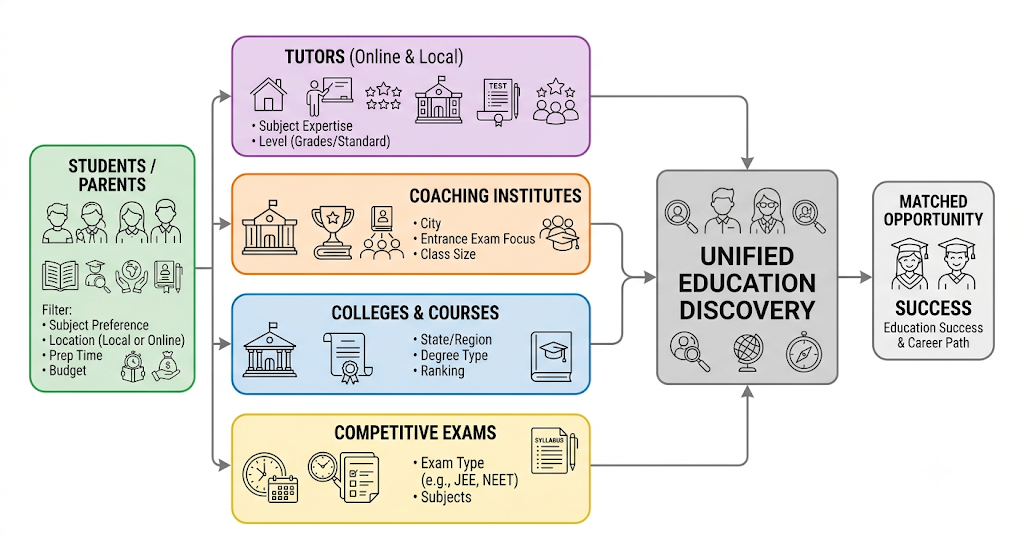
Managing these different academic threads—finding an experienced neighborhood chemistry teacher, evaluating local coaching options, checking university degree requirements, and keeping track of national exam notifications—often means spending hours cross-referencing outdated websites, forums, and local directories.
This is where an education discovery platform simplifies academic planning. Rather than jumping between disconnected sources, learners can explore educational pathways, compare institutions, and find relevant academic resources through GurukulGalaxy, which consolidates discovery into a single, organized interface.
The platform serves as an accessible directory and resource hub, helping users discover:
- Tutors matched to specific learning requirements: Search for independent teachers based on subject, domain expertise, teaching experience, and location preferences—whether you need nearby home tutors for personal guidance or specialized online tutors across India.
- Coaching institute exploration: Discover coaching centers in your immediate area or research established institutes nationwide. Review their academic offerings and explore options suited to specific exam requirements.
- College and university research: Browse structured institution profiles to review available streams, campus facilities, and course structures, making it easy to compare programs before submitting applications.
- Competitive exam guidance: Access up-to-date information on major entrance tests, including eligibility standards, examination patterns, preparation guidelines, and key dates.
By bringing tutors, coaching institutes, colleges, courses, and examination guides together on one platform, students and parents can spend less time managing search logistics and more time focusing on productive learning and long-term planning.
Practical Education Research Tips
Before finalizing any academic enrollment or course commitment, keep these practical guidelines in mind:
- Define the academic goal: Identify the specific learning outcome needed—whether it is foundational concept rebuilding, board exam writing practice, or entrance rank preparation.
- Research multiple alternatives: Shortlist and compare at least two or three tutors, institutes, or colleges side by side rather than choosing the first visible option.
- Verify eligibility and requirements: Check regulatory recognitions, minimum percentage cutoffs, and mandatory subject combinations well ahead of application deadlines.
- Compare fees and accessibility: Account for total costs, including tuition, study materials, transport, and potential relocation expenses, to evaluate overall value.
- Check course and examination details: Review the latest official syllabus, question patterns, and marking schemes directly from primary examination authorities.
- Consider location and schedule: Ensure daily commuting times remain sustainable alongside school hours and personal study time.
- Review available learning resources: Ensure the chosen option provides adequate doubt support, practical lab facilities, and quality revision materials.
- Make decisions based on verified information: Rely on direct interactions, diagnostic sessions, and verified institutional credentials rather than marketing promises.
Frequently Asked Questions
How can students find suitable tutors online?
Students should identify their specific conceptual weaknesses, verify that the educator has direct experience with their school board syllabus, and request an introductory session to evaluate teaching style and communication before committing.
How do I choose between an online tutor and an offline coaching institute?
The choice depends on personal learning habits, self-discipline, and logistics. Offline coaching institutes offer fixed routines, peer interaction, and physical supervision. Online tutors provide individualized pacing, zero commute time, and targeted support for specific weak subjects. Many students use a balanced approach, attending an institute or school for broad syllabus coverage and working with a private tutor for difficult topics.
What factors matter most when comparing undergraduate degree courses?
Focus on the specific department curriculum, elective choices, faculty credentials, laboratory and research infrastructure, and median placement records for that particular branch, rather than relying solely on the institution’s overall brand name.
When should students begin preparing for national competitive exams?
Comprehensive national entrance tests with extensive syllabi, such as JEE, NEET, or CLAT, generally benefit from an organized 18-to-24-month roadmap starting in Class 11. Conversely, general aptitude tests like CUET or regional entrance assessments can often be approached effectively with 6 to 12 months of structured preparation, provided high school fundamentals are sound.
Can an education discovery platform help with both local and national searches?
Yes. A structured discovery platform organizes information by location and academic category, allowing users to search for neighborhood tutors within their immediate area while researching national universities and entrance exams across India from the same website.
Conclusion
Making well-informed academic choices requires time, clear information, and an understanding of a student’s personal goals. Rushing into tuition programs, coaching batches, or degree courses without careful research often leads to unnecessary stress and academic frustration.
By systematically evaluating tutors, verifying coaching institutes, comparing college curricula, and understanding competitive entrance pathways, families can plan each stage with confidence. Utilizing dedicated discovery platforms like GurukulGalaxy helps bring these scattered resources into one organized place, giving students and parents the clarity they need to make sound educational choices.
Leave a Reply