The Cloud Operations Roadmap: From Infrastructure Basics to Advanced Reliability
Introduction
Deploying an application to a cloud provider is often treated as the finish line of a new software project. Yet, for engineering teams, getting code running in a cloud environment is only the first step. Once infrastructure goes live, teams must continuously manage compute resources, storage volumes, networking configurations, relational databases, container clusters, Identity and Access Management (IAM) policies, security updates, backups, and operational costs.
As cloud environments grow from a single development account into multi-region enterprise architectures, manual management quickly breaks down. Configuration drift sets in, security gaps emerge, and operational overhead scales upward. This is where modern cloud operations come into play.
CloudOps is an approach for operating cloud environments with better automation, visibility, security, and reliability. For professionals and teams seeking to dive deeper into these methodologies, platforms like CloudOpsNow serve as valuable educational resources for exploring cloud infrastructure management, automation, and operational standards.
What Is Cloud Operations?
Cloud operations encompasses all the daily administrative, maintenance, and engineering tasks required to keep cloud-based systems running smoothly. Unlike traditional on-premises IT operations—which focus heavily on physical hardware, data center racks, and manual equipment maintenance—cloud operations deals with virtualized, API-driven infrastructure.
Key areas of focus include:
- Provisioning: Creating and tearing down virtual servers, networks, and databases programmatically.
- Configuration: Ensuring software packages, security baselines, and runtime environments are applied consistently.
- Resource Lifecycle Management: Upgrading operating systems, retiring deprecated instances, and scaling resources up or down.
- Networking: Configuring virtual private clouds, subnets, route tables, firewalls, and load balancing.
- Identity and Access: Managing user permissions, service accounts, roles, and credential rotation.
- Monitoring and Logging: Collecting telemetry data to understand system health and performance.
- Incident Response: Investigating outages, mitigating issues, and restoring service availability.
- Backup and Disaster Recovery: Executing routine snapshots, replicating data across regions, and testing recovery procedures.
- Performance Optimization: Analyzing resource utilization to eliminate bottlenecks and optimize cloud spend.
- Governance: Enforcing organizational compliance, tagging standards, and security guardrails.
To understand the difference between deployment and operations, consider a database instance. Deploying infrastructure involves spinning up the database engine through a web console once. Operating infrastructure continuously involves managing storage scaling, rotating master passwords, running routine backups, monitoring replication lag, and applying security patches over a multi-year lifecycle.
What Is CloudOps?
CloudOps is the cultural and technical evolution of IT operations tailored specifically for cloud-native architectures. It combines system administration principles with software engineering methodologies.
The primary goal of CloudOps is to make infrastructure management as automated, reliable, and repeatable as software delivery. Rather than treating servers as permanent pets that require manual care, CloudOps treats infrastructure as ephemeral, version-controlled code.
CloudOps responsibilities span infrastructure provisioning, automated testing, continuous monitoring, observability, automated remediation, security policy enforcement, and operational governance. By bridging the gap between developers who write code and infrastructure teams who manage environments, CloudOps helps organizations scale their cloud footprint without a linear increase in operational headcount.
CloudOps vs DevOps vs SRE
Engineering teams frequently use terms like CloudOps, DevOps, and Site Reliability Engineering (SRE) interchangeably, but they represent distinct operational focus areas.
| Discipline | Main Focus | Typical Responsibilities |
| CloudOps | Cloud infrastructure operations | Provisioning, monitoring, governance |
| DevOps | Software delivery | CI/CD, automation, collaboration |
| SRE | Reliability engineering | SLOs, SLIs, error budgets, incident response |
These disciplines frequently overlap within modern engineering organizations. For instance, a DevOps pipeline might trigger an Infrastructure as Code deployment managed by CloudOps principles, while an SRE team defines the reliability metrics for the resulting service.
Cloud Operations Management
Cloud operations management helps organizations maintain control over distributed environments. Without centralized management, cloud environments can quickly spiral out of control.
Core management responsibilities include resource provisioning, configuration management, IAM policy enforcement, continuous monitoring, incident response coordination, backup scheduling, disaster recovery planning, capacity planning, performance tuning, cost monitoring, and governance compliance. Standardized operational processes ensure that different engineering teams adhere to security and reliability baselines as the organization scales.
Cloud Infrastructure Management
Managing cloud infrastructure requires handling a diverse set of cloud-native building blocks. Engineers must maintain consistency across compute instances, object storage, virtual networks, managed databases, load balancers, container registries, Kubernetes clusters, DNS records, and IAM policies.
Without structured management, environments quickly diverge. Development, staging, and production clusters drift apart, leading to unpredictable failures.
The typical lifecycle of a cloud infrastructure component follows a structured path:
Plan
↓
Provision
↓
Configure
↓
Deploy
↓
Monitor
↓
Optimize
↓
Scale
↓
Retire
Each stage requires careful validation to ensure that infrastructure changes do not disrupt running applications.
Cloud Automation
Manual cloud operations become extremely difficult at scale. If an engineer must manually click through a web console to create virtual machines, configure firewalls, and attach storage volumes, human error is almost guaranteed.
Cloud automation replaces manual toil with repeatable code and scripts. Key areas of automation include:
- Automated Provisioning: Spin up entire multi-tier environments using templates.
- Configuration Management: Automatically apply security baselines and software updates.
- CI/CD Integration: Automatically test and deploy infrastructure changes alongside application code.
- Automated Scaling: Adjust compute capacity dynamically based on real-time traffic demand.
- Automated Remediation: Trigger self-healing workflows when known failure states occur.
- Policy Enforcement: Automatically scan infrastructure definitions for security compliance before deployment.
- Scheduled Operations: Automate routine backups, snapshot rotations, and environment shutdowns.
The primary benefits include consistency, repeatability, reduced manual effort, faster operations, easier recovery, and better auditability. However, automation requires rigorous testing and safeguards. A poorly configured automation script can accidentally delete production databases just as easily as it can provision them.
Infrastructure as Code
Infrastructure as Code (IaC) is the practice of defining and provisioning infrastructure through machine-readable definition files rather than manual configuration tools. Terraform is a widely used example of an IaC tool.
IaC brings software engineering best practices to infrastructure management. Key benefits include declarative configuration files, version control integration via Git, peer code reviews, repeatable multi-environment creation, and change tracking.
A typical IaC workflow ensures that all changes are vetted before they touch live environments:
Git Commit
↓
Validation
↓
Plan
↓
Review
↓
Approval
↓
Apply
↓
Monitoring
This process prevents uncontrolled manual changes, ensuring that the actual state of the cloud environment matches the desired state defined in version control.
Cloud Monitoring and Observability
Visibility is essential for effective cloud operations. Teams cannot manage what they cannot see. While monitoring and observability are often grouped together, they serve different purposes.
| Signal | Purpose |
| Metrics | Measure system behavior |
| Logs | Record detailed events |
| Traces | Follow requests across services |
| Alerts | Notify teams about actionable conditions |
Monitoring helps identify that something is wrong by tracking predefined indicators (e.g., CPU utilization exceeds 90%). Observability helps engineers investigate why it is wrong by inspecting internal states through high-cardinality metrics, structured logs, and distributed traces.
A common operational pitfall is alert fatigue. When systems flood engineers with low-value, non-actionable alerts, critical warnings get ignored. Effective cloud monitoring focuses on defining high-signal, actionable alerting policies.
AWS, Azure and GCP Cloud Management
While AWS, Microsoft Azure, and Google Cloud have different services and interfaces, many operational principles remain remarkably similar.
| Area | AWS | Azure | Google Cloud |
| Compute | EC2, Lambda | Virtual Machines, Azure Functions | Compute Engine, Cloud Functions |
| Containers | ECS/EKS ecosystem | AKS ecosystem | GKE ecosystem |
| Monitoring | AWS monitoring ecosystem | Azure monitoring ecosystem | Google Cloud monitoring ecosystem |
| IaC | Terraform/native tooling | Terraform/native tooling | Terraform/native tooling |
| Identity | AWS IAM ecosystem | Microsoft Entra/IAM ecosystem | Google Cloud IAM ecosystem |
Understanding underlying concepts—such as virtual networking, security groups, block storage, and IAM policies—makes it easier to operate across multiple cloud providers without needing to relearn fundamental engineering principles.
Multi-Cloud Management
Many organizations adopt a multi-cloud strategy to avoid vendor lock-in, leverage best-of-breed services, or meet geographic compliance requirements. However, multi-cloud management introduces significant complexity.
Operating across AWS, Azure, and GCP simultaneously means managing different APIs, distinct IAM permission models, divergent networking topologies, fragmented monitoring toolchains, and varying cost structures.
To succeed in multi-cloud operations, teams must standardize their toolsets—using cloud-agnostic IaC tools like Terraform, centralized identity federation, and unified observability platforms—to reduce operational friction and maintain consistent security governance.
Cloud Operations Best Practices
Implementing proven best practices helps engineering teams maintain resilient, secure, and cost-effective environments:
- Use Infrastructure as Code: Define all cloud resources programmatically.
- Version-control infrastructure: Store all IaC templates in Git repositories.
- Apply least-privilege access: Grant users and services only the permissions they need.
- Standardize naming and tagging: Keep resource names and billing tags organized.
- Monitor critical services: Track key performance indicators that impact end users.
- Reduce alert noise: Filter out low-value warnings to prevent alert fatigue.
- Centralize logs where appropriate: Aggregate audit and application logs for analysis.
- Automate repetitive operations: Eliminate manual runbook tasks through scripting.
- Detect configuration drift: Regularly scan environments for unauthorized manual changes.
- Test backups and recovery: Verify that snapshots and disaster recovery plans actually work.
- Document operational procedures: Maintain clear, up-to-date runbooks for common incidents.
- Review cloud costs: Analyze billing reports regularly to identify idle resources.
- Use controlled change management: Require code reviews for infrastructure modifications.
- Continuously improve reliability: Learn from past outages and refine operational guardrails.
Cloud Security and Governance
Security in the cloud is a shared responsibility between the cloud provider and the customer. While providers secure the underlying data centers and hypervisors, organizations remain responsible for securing their data, applications, IAM configurations, and network firewalls.
Effective cloud operations integrate security directly into daily workflows. This includes enforcing least-privilege access, managing secrets securely through dedicated vaults, enabling robust encryption at rest and in transit, and enforcing compliance policies via policy-as-code tools.
Reliability and Incident Management
Reliability is a core outcome of mature cloud operations. When incidents inevitably occur, structured incident management minimizes downtime and user impact.
The incident lifecycle follows a clear path:
Detect
↓
Triage
↓
Mitigate
↓
Recover
↓
Analyze
↓
Improve
Reliability engineering relies on specific metrics:
- SLI (Service Level Indicator): A quantitative measure of service reliability (e.g., HTTP request latency).
- SLO (Service Level Objective): A target reliability level agreed upon by the team (e.g., 99.9% of requests succeed within 200ms).
- Error Budget: The allowable amount of unreliability a service can experience before triggering corrective freezes on new feature releases.
When incidents happen, a blameless post-incident review helps teams identify root causes, update automation scripts, and improve documentation to prevent recurrence.
Practical CloudOps Workflow
A standard operational workflow ensures that infrastructure changes move smoothly from concept to production:
Infrastructure Requirement
↓
Infrastructure as Code
↓
Code Review
↓
Automated Validation
↓
Provisioning
↓
Security Checks
↓
Application Deployment
↓
Monitoring
↓
Alerting
↓
Incident Response
↓
Optimization
↓
Continuous Improvement
Each stage builds upon the previous one, ensuring high quality and safety before changes impact live users.
Common CloudOps Challenges
| Challenge | Typical Cause | Practical Response |
| Configuration Drift | Manual changes | IaC and drift detection |
| Alert Fatigue | Too many low-value alerts | Actionable alert policies |
| Infrastructure Sprawl | Uncontrolled resources | Governance and lifecycle controls |
| Cost Surprises | Limited visibility | Budgets, tagging and cost monitoring |
| Slow Recovery | Missing runbooks | Documented response procedures |
| Security Misconfiguration | Inconsistent controls | Least privilege and policy automation |
Addressing these challenges early prevents small operational annoyances from turning into major outages.
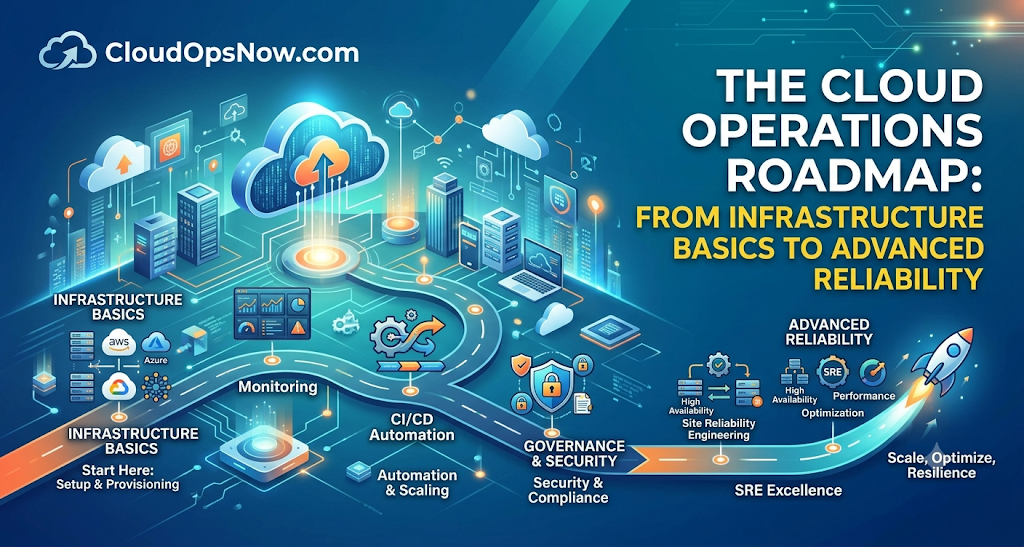
CloudOps Learning Roadmap
For beginners and engineers looking to build expertise in cloud operations, following a structured learning path is essential:
- Linux fundamentals: Understand file systems, processes, permissions, and shell scripting.
- Networking: Learn TCP/IP, DNS, subnets, routing, and firewalls.
- Cloud fundamentals: Study basic compute, storage, and networking concepts.
- AWS, Azure or GCP: Gain hands-on experience with one major cloud provider.
- Git: Master version control workflows and branching strategies.
- Infrastructure as Code: Learn Terraform or native configuration tools.
- CI/CD: Understand automated build, test, and deployment pipelines.
- Containers: Learn Docker and containerization principles.
- Kubernetes: Understand container orchestration and cluster management.
- Monitoring and observability: Set up metrics, structured logging, and tracing.
- Cloud security: Practice IAM, least privilege, and secrets management.
- Automation: Write scripts to eliminate routine operational toil.
- SRE: Study reliability metrics, error budgets, and incident management.
- Multi-cloud operations: Explore governance across multiple providers.
Frequently Asked Questions
1. What is cloud operations?
Cloud operations encompasses all administrative, maintenance, and engineering tasks required to run cloud-based infrastructure reliably and securely over its lifecycle.
2. What is CloudOps?
CloudOps is the modern discipline of applying software engineering, automation, and continuous monitoring principles to cloud infrastructure management.
3. How is CloudOps different from DevOps?
DevOps focuses primarily on software delivery pipelines and collaboration, whereas CloudOps focuses specifically on running and maintaining cloud infrastructure.
4. What is cloud operations management?
It is the centralized administration and governance of cloud resources, security policies, billing, and operational workflows.
5. What is cloud infrastructure management?
It is the administration of compute, storage, networking, databases, and container resources across cloud environments to ensure performance and consistency.
6. Why is cloud automation important?
Automation eliminates manual errors, speeds up provisioning, enforces consistent configurations, and allows teams to scale operations efficiently.
7. What is Infrastructure as Code?
Infrastructure as Code is the practice of managing and provisioning cloud environments using machine-readable definition files and version control.
8. What is cloud monitoring?
Cloud monitoring involves collecting metrics and logs to track system health, identify faults, and notify engineers when operational conditions require attention.
9. What is multi-cloud management?
Multi-cloud management involves overseeing workloads, security, and governance across more than one public cloud provider.
10. How can someone start learning CloudOps?
Beginners should start with Linux and networking fundamentals, learn a primary cloud provider, master Git and Infrastructure as Code, and gradually explore containerization and observability.
Key Takeaways
- CloudOps is an ongoing operational discipline that extends far beyond initial infrastructure deployment.
- Cloud infrastructure requires continuous management to prevent configuration drift and security gaps.
- Automation reduces repetitive manual work and improves operational speed.
- Infrastructure as Code improves consistency and enables version-controlled environments.
- Monitoring and observability support effective troubleshooting and system visibility.
- Security and governance belong in daily operations rather than as an afterthought.
- Multi-cloud introduces additional operational complexity that requires standardized tooling.
- Reliability requires continuous measurement, disciplined incident management, and ongoing improvement.
Conclusion
Operating modern cloud infrastructure requires more than traditional system administration skills. By embracing CloudOps principles—such as Infrastructure as Code, automated provisioning, robust observability, and rigorous security governance—engineering teams can tame infrastructure complexity. Whether managing a single AWS account or navigating a complex multi-cloud environment, a disciplined operational approach ensures systems remain secure, resilient, and ready to scale.
Leave a Reply