Designing Enterprise Security: A Practical Guide to Microsoft Cybersecurity Architecture
Introduction
Managing enterprise IT security grows more complex every day. Organizations no longer operate within a single, easily protected physical office. Instead, operations rely on a web of cloud platforms, software services, remote devices, internal applications, and sensitive business data.
Protecting these distributed systems requires a broader approach than simply buying and configuring isolated security software. Installing an antimalware tool on laptops or turning on a firewall for a single cloud server leaves critical visibility gaps. If these individual tools do not work together, security teams end up with fragmented access controls and missed threat signals.
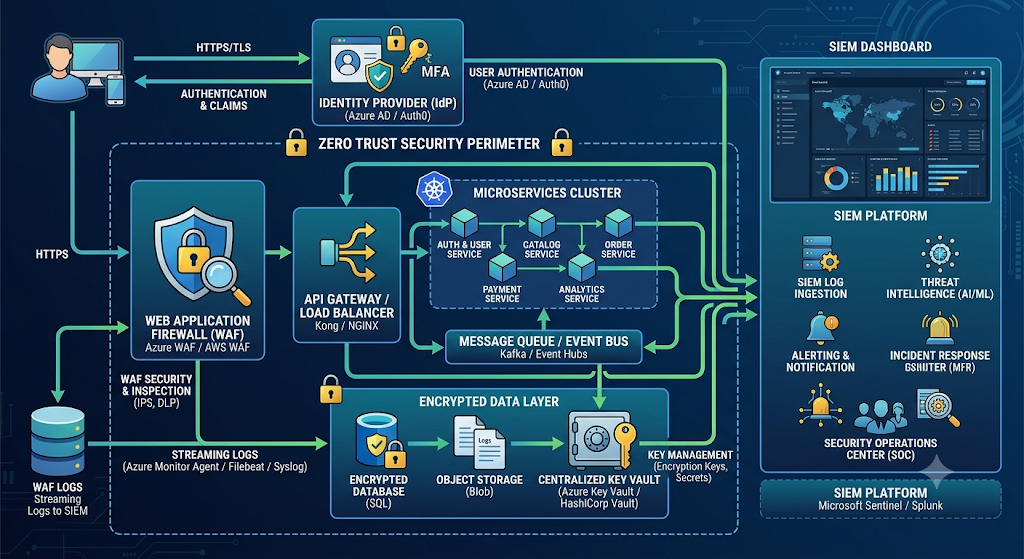
Modern defense depends on a comprehensive security strategy that connects identity systems, cloud infrastructure, network boundaries, and threat monitoring into a unified framework. Professional validations like the Microsoft Certified Cybersecurity Architect Expert help IT and security professionals build the knowledge needed to design and evaluate these end-to-end architectures.
What Is Microsoft Certified Cybersecurity Architect Expert?
A cybersecurity architect serves as a strategic designer within an organization. Rather than managing daily alert queues or patching individual software instances, an architect evaluates overall business goals, technical requirements, and organizational risks to create integrated security plans.
The Microsoft Certified Cybersecurity Architect Expert credential represents an advanced level of professional validation focused on enterprise security design. It is designed for experienced IT professionals who want to translate business needs into practical, secure technical systems across Microsoft and hybrid environments.
+-------------------------------------------------------------------+
|               Cybersecurity Architecture Knowledge                |
+-------------------------------------------------------------------+
|  - Security Architecture      - Security Operations               |
|  - Identity & Access (IAM)    - Data Protection                   |
|  - Cloud Security             - Application Security              |
|  - Risk Management            - Zero Trust Strategy               |
+-------------------------------------------------------------------+
Key knowledge areas associated with this architecture focus include:
- Security Architecture: Defining enterprise defense baselines, governance models, and technical standards.
- Identity and Access Management: Designing secure directory structures, authentication workflows, and access controls.
- Cloud Security: Safeguarding public cloud platforms, hybrid infrastructure, and containerized workloads.
- Security Operations: Structuring continuous monitoring, event collection, and automated incident response workflows.
- Data Protection: Safeguarding sensitive information throughout its lifecycle across distributed networks and storage systems.
- Application Security: Integrating security checks directly into development pipelines and API management.
- Risk Management & Zero Trust: Building systems based on the premise that implicit trust must be eliminated across every access layer.
This certification focus is well suited for security engineers, cloud architects, DevSecOps practitioners, system administrators, and consultants preparing for strategic design roles.
Why Cybersecurity Architecture Matters
Deploying security tools without an overarching architectural strategy often results in fragmented protection. When defensive tools function independently, system administrators face unnecessary maintenance overhead, conflicting access rules, and limited visibility into emerging threats.
An architectural approach provides the blueprint that connects individual security controls together. A structured architecture addresses several key organizational requirements:
- Decentralized Network Boundaries: Workforces operate from everywhere, meaning physical corporate network perimeters no longer serve as reliable security boundaries.
- Identity as the Primary Perimeter: User credentials and service accounts are prime targets for unauthorized access, making identity management the foundation for resource protection.
- Widespread Data Storage: Sensitive files travel across local hardware, SaaS tools, and multi-cloud environments, requiring unified data protection standards.
- Connected Applications: Modern software relies heavily on third-party APIs and microservices, creating new interaction points that require secure configuration.
- Centralized Threat Detection: Disjointed tools generate isolated alerts. Security architecture routes telemetry from multiple layers into central monitoring platforms to speed up threat identification and containment.
Core Skills of a Cybersecurity Architect
A cybersecurity architect combines technical depth with strategic planning. Core technical and operational competencies include:
- Security Architecture Design: Creating repeatable, safe technical designs that support business objectives while reducing operational risk.
- Identity and Access Management (IAM): Designing authentication models, multi-factor authentication policies, Conditional Access rules, and privilege controls.
- Cloud Security: Securing public cloud resources, virtual networks, compute environments, and hybrid connections.
- Network Security: Designing network segmentation, secure gateway boundaries, and encrypted traffic routes.
- Application Security: Collaborating with software teams to enforce secure coding standards, API safeguards, and secrets management.
- Data Security: Establishing automated data classification, loss prevention policies, and encryption standards across active and stored data.
- Security Monitoring: Planning event logging schemas, SIEM data ingestion routes, and automated incident response workflows.
- Threat Protection: Designing proactive defenses that identify anomalies and isolate compromised assets quickly.
- Risk Assessment & Governance: Evaluating technical decisions against regulatory requirements, business goals, and organizational risk tolerance.
- Zero Trust Strategy: Applying continuous verification models and least-privilege principles across every infrastructure layer.
Microsoft Security Technologies and Concepts
Designing security architectures within Microsoft environments involves combining multiple native services so that security telemetry flows between platforms:
                  +-----------------------------------+
                  |        Microsoft Sentinel         |
                  |  (Central Monitoring & Response)  |
                  +-----------------------------------+
                                    ^
                                    | Signals & Logs
        +---------------------------+---------------------------+
        |                           |                           |
+---------------+           +---------------+           +---------------+
| Microsoft     |           | Microsoft     |           | Microsoft     |
| Entra ID      |           | Defender      |           | Purview       |
| (Identity)    |           | (XDR / Threat)|           | (Data Guard)  |
+---------------+           +---------------+           +---------------+
- Microsoft Entra ID: A cloud identity and access management platform that handles single sign-on, identity governance, Conditional Access policies, and privilege management.
- Microsoft Defender: A family of Extended Detection and Response (XDR) solutions protecting endpoints, cloud workloads, identities, SaaS software, and email systems.
- Microsoft Sentinel: A cloud-native Security Information and Event Management (SIEM) and automation platform used to analyze logs and coordinate incident response across enterprise systems.
- Microsoft Purview: A data governance and compliance suite that helps discover, classify, label, and protect sensitive data across environments.
- Azure Security Capabilities: Infrastructure controls such as Network Security Groups, Azure Key Vault for secrets management, and Web Application Firewalls (WAF).
Understanding how these platform components interact enables architects to build defensive systems that share threat intelligence dynamically.
Understanding Zero Trust
Zero Trust is a security framework designed for modern, connected environments. Traditional security models relied on perimeter defenses, assuming that everything operating inside an internal corporate network could be trusted. Zero Trust replaces this assumption by requiring continuous, explicit verification for every access attempt.
Zero Trust operates on core principles:
- Verify Explicitly: Authenticate and authorize every access request using all available data signals, including user identity, geographic location, device health, and resource sensitivity.
- Use Least Privilege: Limit user access with Just-In-Time (JIT) and Just-Enough-Access (JEA) policies to give individuals only the permissions required for their tasks.
- Assume Breach: Design systems to minimize the impact of an incident. Segment networks, encrypt internal traffic, and continuously monitor for unusual activity.
- Continuously Evaluate Access: Re-evaluate permissions dynamically during active user sessions as risk context changes.
- Protect Identities: Treat identity as the central perimeter controlling access to resources, regardless of where users connect from.
- Secure Devices: Inspect device compliance and security health before granting access to internal resources.
- Secure Applications: Apply protection, monitoring, and explicit API controls across all corporate software.
- Protect Data: Label, classify, and encrypt data so protection remains intact wherever files are stored or moved.
In practice, Zero Trust ensures that internal and external network traffic receive the same level of security scrutiny.
What Does a Cybersecurity Architect Do?
The daily role of a cybersecurity architect involves balancing design work, risk analysis, and collaboration with technical teams:
- Designing Security Architectures: Creating technical drawings, control guidelines, and architecture blueprints for upcoming systems.
- Assessing Security Risks: Evaluating proposed infrastructure changes to spot potential vulnerabilities and risk exposure.
- Selecting Security Controls: Choosing technical safeguards that address risks without creating unnecessary friction for users.
- Reviewing Cloud Security Designs: Checking cloud infrastructure configurations to ensure compliance with security baselines.
- Integrating Security Services: Connecting identity providers, threat protection tools, and monitoring software into a unified workflow.
- Creating Security Standards: Drafting governance policies and baseline standards that engineering teams can follow easily.
- Working With Engineering Teams: Collaborating with DevOps, cloud infrastructure, and network teams during system builds.
- Supporting Incident-Response Planning: Helping SecOps teams build response workflows and containment steps for security incidents.
- Connecting Business Requirements With Controls: Translating executive risk decisions into concrete, operational technical rules.
Important Learning Areas
Developing capabilities in cybersecurity architecture requires focused learning across several interconnected domains.
| Learning Area | What to Learn | Why It Matters |
| Security Architecture | Security principles and architecture design | Helps create secure environments |
| Identity & Access | Authentication, authorization, least privilege | Controls resource access |
| Cloud Security | Cloud workloads and security controls | Protects cloud environments |
| Data Security | Data classification and protection | Reduces data exposure |
| Application Security | Secure application design | Helps reduce application risks |
| Security Operations | Monitoring and response | Supports threat detection |
| Zero Trust | Identity-centric security principles | Strengthens access decisions |
| Risk Management | Threat and risk assessment | Helps prioritize security controls |
Cybersecurity Architect Preparation Roadmap
Transitioning into an architecture role requires a logical progression through foundational concepts, system design, and risk management:
- Build cybersecurity fundamentals: Master core networking, operating system security, common vulnerability types, and risk concepts.
- Learn cloud security: Study public cloud platforms, virtual networks, container deployment security, and shared responsibility models.
- Understand identity and access management: Develop a deep understanding of federated directories, modern authentication protocols, and access management.
- Study Zero Trust: Learn how explicit verification, least privilege, and micro-segmentation apply to technical systems.
- Explore Microsoft security technologies: Study how tools like Microsoft Entra ID, Defender, Sentinel, and Purview work together to safeguard environments.
- Practice security architecture design: Draft architecture diagrams for standard scenarios, such as secure remote access or cloud workload migrations.
- Create security architecture diagrams: Learn to draw clear visual designs showing network boundaries, data paths, and control points.
- Work through realistic security scenarios: Analyze mock environments to spot missing controls and design practical solutions.
- Develop risk-assessment skills: Practice threat modeling, evaluating business impacts, and picking controls that match organizational risk tolerance.
- Review security monitoring and incident-response workflows: Learn how logs flow from source systems into SIEM platforms for real-time analysis.
Hands-On Practice
Hands-on exercises help turn theoretical knowledge into practical design skills:
- Design a Zero Trust Architecture: Configure a lab tenant to enforce Conditional Access rules based on device health and user context.
- Create Identity and Access Scenarios: Set up approval workflows and time-bound administrative access using identity governance controls.
- Review Sample Cloud Security Configurations: Evaluate cloud setting baselines to spot misconfigurations or overly broad permissions.
- Create Threat Models: Pick an application workflow, identify possible attack vectors, and map out protective controls to mitigate risks.
- Map Security Controls to Business Requirements: Take a business requirement—such as securing remote worker connections—and select the technical controls needed to support it.
- Design Incident-Response Workflows: Map out automated containment actions, such as isolating a compromised cloud virtual machine when an alert triggers.
- Create Security Architecture Diagrams: Practice drawing hybrid environments to illustrate data movement, trust boundaries, and logging points.
- Review Sample Architectures for Security Gaps: Examine existing cloud templates to find publicly accessible storage or unencrypted communication paths.
Career Opportunities
Developing security architecture capabilities opens doors to strategic design and technical leadership roles.
Potential career paths include:
- Cybersecurity Architect: Focuses on designing, standardizing, and evaluating security strategies across an enterprise.
- Security Architect: Oversees technical security models, risk management strategies, and baseline control selection.
- Cloud Security Architect: Specializes in securing public, private, and hybrid cloud workloads and platforms.
- Security Engineer: Implements, operates, and maintains technical controls, firewall infrastructures, and detection systems.
- Cloud Security Engineer: Hardens cloud resources, storage systems, and virtual networks.
- Cybersecurity Consultant: Advises clients on security posture assessments, regulatory compliance, and system design.
- Security Solutions Architect: Partners with technical teams to design customized security setups for enterprise customers.
- Security Engineering Lead: Guides technical security deployment teams and ensures technical work aligns with business goals.
- Security Manager: Oversees security teams, strategy execution, compliance tasks, and operational risk.
Note: Acquiring professional skills and certifications supports career growth, but employment outcomes depend on individual experience, continuous learning, and job market conditions.
Cybersecurity Roles Comparison
Understanding how different security roles relate to one another helps professionals plan their career progression:
| Role | Main Focus | Typical Responsibilities |
| Cybersecurity Architect | Overall security design | Architecture, controls, and risk decisions |
| Security Engineer | Security implementation | Configure and maintain security controls |
| Cloud Security Engineer | Cloud protection | Secure cloud infrastructure and workloads |
| SOC Analyst | Threat monitoring | Alert investigation and response |
| Security Consultant | Security guidance | Assessments and recommendations |
| Security Manager | Security leadership | Strategy, governance, teams, and risk |
Benefits of Cybersecurity Architecture Skills
Building expertise in cybersecurity architecture offers several practical advantages for technical professionals:
- Comprehensive Enterprise Perspective: Helps professionals look beyond isolated server or application settings to see how identity, cloud, and network controls fit together.
- Stronger Cloud Security Knowledge: Delivers design skills directly applicable to modern public and hybrid cloud environments.
- Improved Architecture Decision-Making: Teaches how to pick security controls based on measurable risk reduction rather than product popularity.
- Better Risk Assessment Capabilities: Links technical configurations directly to business risk management and compliance requirements.
- Stronger Understanding of Identity Security: Shows how to make identity the primary control point for resource access.
- Better Security-Tool Integration Knowledge: Demonstrates how to connect disjointed systems to share threat signals and speed up response times.
- Broader Career Options: Prepares technical staff for senior engineering, consulting, and strategic architecture leadership positions.
- Better Communication: Helps technical teams articulate security risks clearly to non-technical business leaders and project managers.
Common Cybersecurity Architecture Challenges
Designing secure environments involves managing several common operational hurdles:
- Legacy Systems: Older applications often lack support for modern authentication standards like SAML or OIDC.Approach: Place legacy software behind identity-aware proxies to enforce modern access policies without rewriting source code.
- Complex Cloud Environments: Managing settings across multiple public cloud providers can lead to configuration drift.Approach: Use infrastructure-as-code templates and central posture management tools to keep security policies consistent.
- Identity Sprawl: Unmanaged user accounts across different SaaS tools create orphaned accounts and security risks.Approach: Centralize user management into a primary identity provider with single sign-on and automated account provisioning.
- Excessive Privileges: Giving users broad administrative rights to reduce friction increases damage if accounts are compromised.Approach: Use Just-In-Time access tools that grant elevated permissions only when approved and for limited timeframes.
- Limited Security Visibility: Disjointed log tools keep security teams from seeing threats that span multiple systems.Approach: Collect event logs into a central SIEM platform capable of analyzing data across identity, endpoint, and cloud layers.
- Data Protection Requirements: Tracking sensitive files across remote devices and cloud storage is difficult.Approach: Apply automated data sensitivity labels and loss prevention rules that stay attached to files wherever they move.
- Security-Tool Integration: Running isolated tools increases workload without improving protection.Approach: Choose tools with native API connections and shared threat intelligence capabilities.
- Changing Threats: Attack techniques evolve quickly, rendering static perimeter rules ineffective.Approach: Move from fixed perimeter rules to continuous monitoring and dynamic access verification.
- Security Versus Usability: Strict security measures can prompt users to find workarounds outside official IT channels.Approach: Use contextual policies that trigger extra security checks only when unusual risk indicators are detected.
- Unclear Security Ownership: Undefined team roles lead to unpatched systems and unmanaged risks.Approach: Establish clear governance matrices defining explicit operational responsibilities across engineering and security teams.
Frequently Asked Questions
What is Microsoft Certified Cybersecurity Architect Expert?
It is an advanced professional validation focused on designing, evaluating, and guiding enterprise security architectures across identity, cloud, application, data, and security operations domains.
Who should consider this certification?
Experienced security engineers, cloud architects, DevSecOps practitioners, system administrators, and IT managers looking to step into strategic architecture roles.
What skills should a cybersecurity architect have?
Key skills include identity management design, cloud security architecture, Zero Trust implementation, application security, threat modeling, security operations planning, and risk management.
Why is Zero Trust important?
Zero Trust provides a realistic security strategy for decentralized systems by removing implicit trust, requiring explicit verification, and limiting lateral movement during incidents.
How important is cloud security for cybersecurity architects?
Cloud security is essential. Most enterprise applications run on public or hybrid cloud infrastructure, making cloud protection a core architectural task.
Which Microsoft security technologies should professionals understand?
Key platforms include Microsoft Entra ID, Microsoft Defender, Microsoft Sentinel, Microsoft Purview, and native Azure security tools.
How can beginners prepare for a cybersecurity architect career?
Beginners should build strong fundamentals in networking, operating system security, and cloud basics before moving into identity management, threat modeling, and architecture design.
Key Takeaways
- Beyond Tool Configuration: Cybersecurity architecture connects isolated tools into a unified, manageable defensive framework.
- Identity as the Control Plane: Modern security designs center access decisions around identity governance, dynamic context, and explicit checks.
- Guided by Zero Trust: Effective architectures rely on three core ideas: verify explicitly, use least privilege, and assume breach.
- Balanced Design: Architects balance security controls with user experience, system performance, and organizational risk priorities.
- Integrated Monitoring: Routing telemetry from identity, cloud, and endpoints into a central SIEM platform is vital for real-time visibility.
- Strategic Career Growth: Learning architecture principles helps technical staff transition from reactive administration to proactive system design.
Conclusion
Protecting modern enterprise applications requires moving past isolated security controls and reactive tool configuration. Long-term defense depends on a well-designed security architecture that connects identity management, cloud infrastructure, data protection, application development, and threat monitoring into a single ecosystem.
Cybersecurity architects play a vital role in building these environments, ensuring systems remain secure, compliant, and aligned with organizational goals. For technical professionals seeking to validate their ability to build modern enterprise defenses, studying for the Microsoft Certified Cybersecurity Architect Expert provides a clear path to mastering cybersecurity architecture design.
Leave a Reply