The Complete Overview of Cloud, Kubernetes, DevSecOps, and Managed DevOps Services
Introduction
Engineering teams frequently encounter a paradox as their technical ecosystems grow. An organization may utilize Git version control, continuous integration pipelines, container registries, cloud-native hosting, automated monitoring, and security scanners, yet still experience slow software delivery releases, manual infrastructure changes, frequent production incidents, and growing developer frustration.
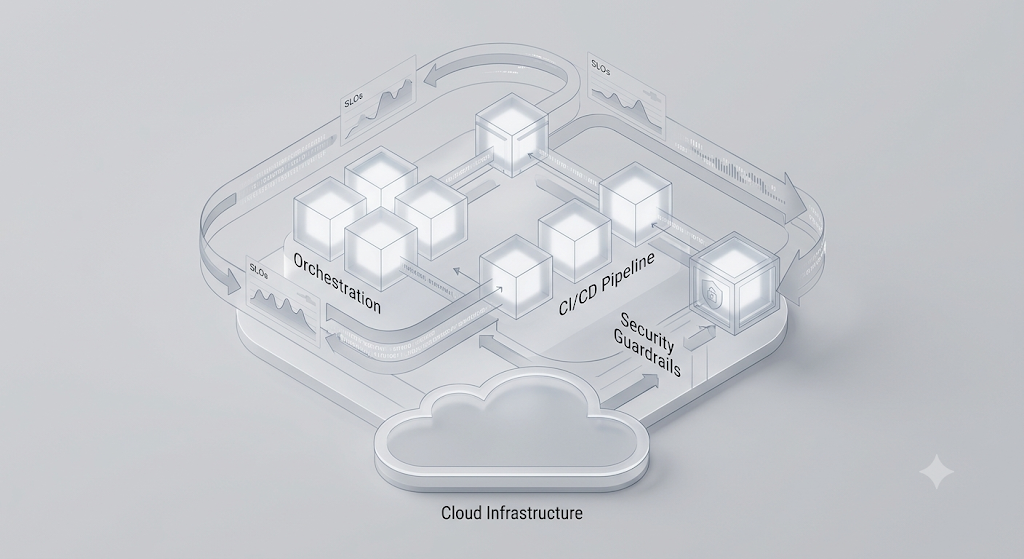
When teams hit this operational wall, the issue is rarely a lack of tooling. Modernizing software delivery requires a cohesive engineering operating model that aligns people, processes, automation, cloud architecture, security, and system reliability. Addressing these challenges often requires structured guidance across multiple technical disciplines, including cloud modernization, container orchestration, security integration, reliability engineering, and internal platform design.
What Are DevOps Consulting Services?
DevOps Consulting Services provide organizations with specialized engineering guidance and execution strategies to improve their software delivery lifecycle and operational practices. Rather than focusing solely on commercial software selection, professional consulting engagements evaluate how applications move from source code commits to running production environments.
A thorough consulting assessment typically reviews:
- CI/CD Workflows: The speed, reliability, and security of automated build, test, and deployment pipelines.
- Infrastructure as Code (IaC): Whether cloud and server environments are defined programmatically or configured manually.
- Automation: The extent to which repetitive administrative tasks are automated across engineering workflows.
- Cloud Infrastructure: The scalability, cost efficiency, and security posture of hosting environments.
- Deployment Processes: How safely code changes are promoted through staging to production.
- Monitoring and Observability: The completeness of telemetry data, metrics, logs, and distributed traces.
- Release Management: Coordination strategies that minimize user disruption during updates.
- Developer Workflows: The administrative friction and cognitive load engineers face during daily development tasks.
Common Problems DevOps Consulting Can Address
Organizations typically seek external technical expertise when internal teams face systemic bottlenecks that slow down engineering output. Common challenges include:
- Slow Deployments: Release cycles that take weeks or months due to manual handoffs and fragile testing stages.
- Manual Infrastructure Work: Relying on engineers to provision servers or configure networks via web consoles, leading to configuration drift.
- Unreliable Releases: Frequent production rollbacks caused by discrepancies between development, testing, and production environments.
- Configuration Drift: Accumulating undocumented changes on servers that make environments difficult to reproduce or repair.
- Poor Observability: Lacking centralized metrics and logging, which turns production troubleshooting into guesswork.
- High Operational Workload: Engineers spending more time maintaining infrastructure than writing application features.
- Security Gaps: Discovering vulnerabilities late in the release cycle or during pre-launch compliance audits.
- Cloud Cost and Scalability Issues: Inefficient resource utilization leading to unpredictable monthly cloud bills and performance degradation under load.
Managed DevOps Services
While consulting engagements are typically advisory or project-based, Managed DevOps Services provide continuous, day-to-day operational support. Organizations often transition to managed services to maintain operational momentum without scaling an internal infrastructure team from scratch.
Managed DevOps support typically includes:
- CI/CD Management: Maintaining pipeline runners, updating build agents, and troubleshooting build failures.
- Infrastructure Monitoring: Overseeing system health, resource saturation, and network performance around the clock.
- Automation: Writing scripts, hooks, and configuration templates to eliminate recurring operational toil.
- Production Support: Managing routine patching, certificate renewals, and system updates.
- Deployment Management: Assisting internal teams with safe, repeatable software releases.
- Incident Response: Participating in on-call rotations, triaging alerts, and executing remediation runbooks.
- Continuous Improvement: Regularly evaluating pipeline efficiency and system architecture for incremental upgrades.
Cloud Consulting Services
Designing resilient cloud environments requires balancing technical performance, security requirements, and financial constraints. Cloud Consulting Services help organizations build secure, scalable, and cost-efficient architectures across major platforms like AWS, Microsoft Azure, and Google Cloud.
Key focus areas include:
- Cloud Architecture: Designing multi-tier applications with proper workload isolation and fault tolerance.
- Platform Specialization: Leveraging native services across AWS, Azure, and Google Cloud effectively.
- Security Baselines: Implementing identity and access management (IAM) models, least-privilege permissions, and data encryption.
- Scalability: Configuring auto-scaling policies to handle dynamic user traffic without manual intervention.
- Cost Management: Establishing resource visibility, right-sizing instances, and leveraging reserved capacity.
- Infrastructure Automation: Deploying repeatable environments using tools like Terraform, OpenTofu, or cloud-native templates.
Cloud Migration Services
Moving legacy applications and workloads to modern cloud platforms requires careful planning to prevent data loss or extended downtime. A practical cloud migration lifecycle follows a structured engineering sequence:
Assessment → Application Discovery → Dependency Mapping → Migration Strategy → Application Preparation → Infrastructure Preparation → Testing → Migration → Validation → Optimization
Common Migration Approaches
- Rehosting (Lift and Shift): Moving applications to cloud infrastructure with minimal code changes, prioritizing speed of migration.
- Replatforming: Making minor optimizations to leverage managed cloud services (such as shifting a self-hosted database to a managed SQL service) without altering core architecture.
- Refactoring: Re-architecting legacy code into cloud-native microservices to take full advantage of elastic scaling and containerization.
- Hybrid Approaches: Maintaining certain workloads on-premises while migrating non-sensitive or high-scale components to public cloud environments.
Kubernetes Consulting Services
Container orchestration platforms offer immense power for scalable applications, but operating clusters in production introduces significant architectural complexity. Kubernetes Consulting Services help enterprises design, deploy, secure, scale, and optimize container platforms.
Essential focus areas include:
- Cluster Architecture: Designing node topologies, control plane security, and multi-tenant namespace boundaries.
- Container Orchestration: Managing deployments, stateful sets, daemon sets, and persistent storage volumes.
- Managed Platforms: Configuring and optimizing managed Kubernetes services, including Amazon EKS, Azure AKS, and Google GKE.
- Security: Enforcing role-based access control (RBAC), network policies, and pod security standards.
- Scaling: Implementing Horizontal Pod Autoscalers (HPA) and Cluster Autoscalers based on resource utilization metrics.
- Networking: Configuring Ingress controllers, service meshes, and DNS resolution for inter-service communication.
- Monitoring: Integrating container metrics collectors, log forwarders, and distributed tracing agents.
- Deployment Automation: Utilizing GitOps workflows (such as Argo CD or Flux) to manage cluster state declaratively.
DevSecOps Consulting Services
Security should be an integrated element of the software delivery lifecycle rather than a final gatekeeping checkpoint before production. DevSecOps Consulting Services embed compliance, vulnerability management, and automated security controls directly into CI/CD pipelines.
Core integration areas include:
- Static Application Security Testing (SAST): Scanning source code for vulnerabilities and insecure coding patterns during the build phase.
- Dynamic Application Security Testing (DAST): Evaluating running applications for security flaws in test environments.
- Dependency Scanning: Checking third-party libraries, modules, and base images for known Common Vulnerabilities and Exposures (CVEs).
- Container Scanning: Inspecting container image layers for vulnerabilities before pushing them to registries.
- Secrets Management: Preventing hardcoded credentials by integrating tools like HashiCorp Vault or cloud secret managers.
- Infrastructure Security: Scanning Infrastructure as Code templates for misconfigurations prior to provisioning.
- Policy Enforcement: Automated guardrails that block non-compliant builds or unauthorized resource deployments.
- Compliance Automation: Continuously gathering audit evidence and configuration states to satisfy regulatory standards.
SRE Consulting Services
Site Reliability Engineering applies software engineering principles to infrastructure and operations problems. SRE Consulting Services focus on establishing sustainable operational frameworks that balance feature velocity with system stability.
Core SRE concepts include:
- Reliability Engineering: Designing systems to tolerate component failures gracefully without total outages.
- Service Level Indicators (SLIs): Quantifiable metrics measuring system performance, such as request latency or error rates.
- Service Level Objectives (SLOs): Target reliability thresholds agreed upon by engineering and product teams for those SLIs.
- Error Budgets: The allowable unreliability window calculated from SLOs, providing a metric to balance speed and stability.
- Incident Management: Establishing clear escalation paths, on-call rotations, and structured communication during outages.
- Observability: Unifying metrics, logs, and traces to understand internal system states from external outputs.
- Alerting: Tuning alert thresholds to notify engineers of actionable issues while reducing alert fatigue.
- Capacity Planning: Forecasting resource requirements based on historical traffic patterns and business growth.
- Post-Incident Reviews: Conducting blameless post-mortems to identify root causes and implement preventative automation.
Platform Engineering Consulting Services
As microservices and cloud architectures expand, developers often experience cognitive overload dealing with fragmented infrastructure tools. Platform Engineering Consulting Services help engineering teams build internal developer platforms (IDPs).
Key components of platform engineering include:
- Internal Developer Platforms: Centralized self-service portals where developers can provision authorized resources and manage application lifecycles.
- Golden Paths: Pre-packaged, compliant templates for common application architectures, databases, and CI/CD pipelines.
- Self-Service Infrastructure: Allowing developers to spin up staging or test environments instantly without manual ticketing workflows.
- Reusable Templates: Standardized configuration modules that reduce duplicate scripting across different engineering squads.
- Deployment Standards: Consistent mechanisms for promoting code safely across environments.
- Developer Experience (DevEx): Minimizing administrative friction so engineers can focus on writing core business logic.
DevOps Outsourcing Services
When organizations face urgent project deadlines, temporary headcount constraints, or specialized skill gaps, DevOps Outsourcing Services provide access to external engineering talent.
Benefits and Considerations
- Access to Specialized Skills: Bringing in professionals certified in advanced cloud, container, and security practices.
- Accelerated Capacity: Rapidly scaling engineering bandwidth for major migration or modernization initiatives.
- Flexible Engagement: Adjusting external staffing levels based on project milestones and operational demands.
- Communication Overhead: Requiring deliberate collaboration structures to prevent silos between internal and external teams.
- Knowledge Retention: Ensuring that outsourced engineering work includes thorough documentation and handoffs to avoid vendor dependency.
Corporate DevOps Training
External consulting provides immediate project acceleration, but long-term success relies on internal team capability. Corporate DevOps Training helps enterprise teams strengthen practical skills across modern technical stacks.
Structured training programs typically cover:
- DevOps principles and collaborative engineering culture
- CI/CD pipeline design and maintenance
- Cloud platform administration and architecture
- Kubernetes cluster management and container orchestration
- DevSecOps integration and automated security scanning
- Site Reliability Engineering practices, SLIs, and SLOs
- Infrastructure as Code and automation scripting
How These Services Fit Together
DevOps modernization is rarely achieved through isolated interventions. Instead, consulting services, managed operations, cloud migration, container orchestration, security integration, reliability engineering, platform design, outsourcing, and training form a connected improvement strategy.
Organizations typically progress through a logical engineering maturity path:
Assessment
↓
CI/CD and Infrastructure Automation
↓
Cloud Modernization
↓
Kubernetes and Container Platforms
↓
DevSecOps
↓
Observability and SRE
↓
Platform Engineering
↓
Continuous Improvement
Adopting this progression allows organizations to address fundamental delivery bottlenecks before tackling advanced platform engineering or automated governance.
Practical DevOps Workflow Example
A mature software delivery workflow integrates automation and observability across every stage of the application lifecycle:
Code
→ Build
→ Test
→ Security Scan
→ Package
→ Deploy
→ Monitor
→ Feedback
- Code: Developers commit code to version control repositories with automated pull request checks.
- Build: CI pipelines compile code, resolve dependencies, and generate immutable artifacts.
- Test: Automated unit, integration, and regression tests execute in isolated environments.
- Security Scan: SAST tools and dependency scanners check the codebase for vulnerabilities.
- Package: Container images are built, tagged, and pushed to secure registries with image vulnerability checks.
- Deploy: GitOps controllers or deployment pipelines roll out artifacts to staging and production clusters.
- Monitor: Observability platforms collect telemetry, tracking SLIs and error rates in real-time.
- Feedback: Telemetry data and incident insights feed back into development planning for continuous optimization.
Service Comparison Table
| Service | Main Focus | Typical Activities | Best For |
| DevOps Consulting Services | Delivery workflow transformation | Assessing pipelines, introducing IaC, streamlining releases | Organizations struggling with slow or manual software releases |
| Managed DevOps Services | Ongoing operations | Monitoring infrastructure, managing CI/CD, handling incident response | Teams needing continuous operational support without hiring internal overhead |
| Cloud Consulting Services | Cloud architecture design | Building multi-tier environments, optimizing cloud spend across AWS, Azure, GCP | Businesses scaling cloud footprints or optimizing infrastructure costs |
| Cloud Migration Services | Workload migration | Dependency mapping, rehosting, refactoring legacy applications | Enterprises modernizing legacy datacenters and moving workloads to the cloud |
| Kubernetes Consulting Services | Container orchestration | Designing EKS/AKS/GKE clusters, securing workloads, configuring autoscaling | Organizations adopting container platforms or managing complex cluster operations |
| DevSecOps Consulting Services | Security integration | Automating SAST/DAST, implementing secrets management, enforcing compliance | Teams looking to catch vulnerabilities early in the delivery pipeline |
| SRE Consulting Services | System reliability | Defining SLIs/SLOs, setting up error budgets, improving incident management | Businesses experiencing frequent outages or lacking measurable reliability targets |
| Platform Engineering Consulting Services | Internal developer experience | Building self-service portals, creating golden paths, standardizing deployment workflows | Growing engineering organizations suffering from infrastructure fragmentation |
| DevOps Outsourcing Services | Staff augmentation | Providing experienced cloud, Kubernetes, and reliability engineers | Companies facing acute skill shortages or tight project delivery deadlines |
| Corporate DevOps Training | Team upskilling | Conducting hands-on workshops in cloud, Kubernetes, SRE, and automation | Enterprises building long-term internal technical capabilities |
Common Challenges and Practical Responses
| Challenge | Possible Impact | Practical Response |
| Legacy Infrastructure | High maintenance costs and inability to scale | Implement phased cloud migration and containerization strategies |
| Manual Deployments | Human error, deployment anxiety, and slow release cadences | Build automated CI/CD pipelines and enforce Infrastructure as Code |
| Skill Gaps | Slow project execution and reliance on tribal knowledge | Combine targeted consulting with structured corporate training |
| Security Integration | Late-stage vulnerability discoveries and delayed launches | Embed DevSecOps scanning gates early into the CI/CD pipeline |
| Kubernetes Complexity | Cluster instability, misconfigured resources, and unpredictable costs | Utilize Kubernetes consulting to establish standardized cluster architectures |
| Poor Observability | Extended MTTR (Mean Time to Resolution) during production outages | Implement centralized telemetry collection, structured logging, and SLO tracking |
| Cloud Migration Risks | Unexpected downtime or budget overruns during data cutovers | Execute rigorous dependency mapping and thorough rollback planning |
| Platform Adoption | Developer friction and low engagement with internal tooling | Build user-centric internal developer platforms with clear golden paths |
How to Evaluate a DevOps Consulting Provider
When evaluating external technical partners, engineering leaders should focus on practical engineering competency and collaboration standards:
- Technical Expertise: Demonstrated capability across modern CI/CD tools, version control systems, and automation frameworks.
- Cloud Experience: Proven track record designing and managing resilient environments across AWS, Azure, and Google Cloud.
- Kubernetes Knowledge: Deep operational understanding of cluster networking, storage, security hardening, and autoscaling.
- Security Practices: Commitment to embedding DevSecOps controls and managing secrets securely without slowing down developers.
- SRE Capabilities: Practical experience defining meaningful SLIs, SLOs, and incident response frameworks.
- Automation Skills: Heavy reliance on Infrastructure as Code and declarative configuration management.
- Documentation Quality: Clear, comprehensive operational runbooks and architectural diagrams left behind for internal teams.
- Communication Standards: Transparent project management, predictable reporting, and clear channels of collaboration.
- Knowledge Transfer: A deliberate focus on upskilling internal engineers throughout the engagement.
- Long-Term Support: Flexible transition models from project execution to managed services or independent operation.
Frequently Asked Questions
What are DevOps Consulting Services?
DevOps consulting services provide expert technical guidance and engineering support to help organizations optimize their software delivery workflows, infrastructure automation, and operational reliability.
When should a company use Managed DevOps Services?
Organizations should consider managed services when they require continuous operational support, monitoring, and pipeline maintenance but lack the internal headcount or bandwidth to maintain a dedicated infrastructure team.
What is included in Cloud Consulting Services?
Cloud consulting covers cloud architecture design, multi-cloud strategy (AWS, Azure, Google Cloud), security baselines, scalability planning, cost optimization, and infrastructure automation.
Why are Kubernetes Consulting Services useful for enterprises?
Kubernetes consulting helps enterprises navigate the operational complexity of container orchestration, ensure secure cluster topologies, optimize resource utilization, and prevent common production pitfalls.
How does DevSecOps improve software delivery?
DevSecOps embeds automated security testing, vulnerability scanning, and compliance checks earlier in the delivery lifecycle, allowing teams to catch and remediate issues before code reaches production.
What does an SRE consultant do?
An SRE consultant helps establish service level indicators (SLIs), service level objectives (SLOs), error budgets, observability pipelines, and structured incident response processes to improve system reliability.
What is Platform Engineering Consulting?
Platform engineering consulting assists organizations in building internal developer platforms that provide self-service infrastructure and standardized golden paths, reducing friction for development teams.
When should a company consider DevOps Outsourcing Services?
DevOps outsourcing is appropriate when an enterprise needs specialized technical skills quickly, wants to accelerate project timelines, or requires temporary engineering capacity during modernization initiatives.
Key Takeaways
- DevOps is an overarching engineering operating model that extends far beyond individual software tools.
- Infrastructure as Code eliminates configuration drift and ensures reproducible environments across staging and production.
- Cloud adoption requires careful architectural planning around security, scalability, and cost efficiency.
- Kubernetes requires strict resource management, networking policies, and security hardening to operate reliably at scale.
- Security should be integrated continuously throughout the delivery lifecycle rather than treated as a final checkpoint.
- SRE practices utilize data-driven SLIs, SLOs, and error budgets to balance feature velocity with system reliability.
- Platform engineering improves developer productivity through self-service infrastructure and standardized golden paths.
- Long-term success requires combining technical consulting with continuous team training and knowledge transfer.
Conclusion
Modernizing software delivery, cloud infrastructure, and operational reliability is an incremental journey rather than a single event. Organizations can approach technical transformation step-by-step, addressing high-impact bottlenecks first and gradually expanding automation, security, and platform engineering practices.
For organizations exploring specialized guidance across cloud architecture, Kubernetes, DevSecOps, SRE, platform engineering, and enterprise training, Cotocus provides practical consulting, managed services, and technical enablement tailored to modern standards.
Leave a Reply