Engineering Operations Maturity: Turning Technical Complexity into Measurable Improvement
Introduction
Modern software engineering organizations rarely lack technical sophistication. Most teams already run containerized workloads on managed Kubernetes clusters, automate builds through continuous integration pipelines, aggregate logs in centralized platforms, and provision cloud infrastructure through declarative templates. Yet as architectures scale across dozens of microservices, multiple cloud accounts, and expanding compliance demands, engineering leaders frequently encounter a frustrating paradox: technical capabilities expand on paper while day-to-day operational reliability feels increasingly fragile. Incidents take longer to diagnose, release confidence varies wildly between squads, and cloud bills climb without a clear link to customer traffic. Measuring—let alone improving—operational maturity becomes difficult because teams lack a shared, evidence-based baseline for what “good” actually looks like in production.
Modern Tooling Is Not the Same as Operational Maturity
A persistent misconception in software operations is treating tool adoption as proof of operational capability. Buying an observability suite, installing a service mesh, or deploying an internal developer portal does not automatically produce reliable systems. Tools amplify existing engineering habits. If a service lacks clear ownership, meaningful health checks, or tested rollback paths, introducing complex distributed software simply multiplies failure modes and increases cognitive load on on-call engineers.
True operational maturity emerges when three elements reinforce each other: repeatable technical practices, explicit organizational ownership, and lightweight operational processes. A mature team does not just run a CI/CD server; it enforces automated testing, artifact signing, and deterministic rollbacks under five minutes. It does not merely collect terabytes of telemetry; it ties alerts directly to user-facing reliability objectives and documented runbooks. Distinguishing between software inventory and operational execution is the first step toward building resilient systems.
Core Domains of Engineering Operations
Understanding operational health requires looking beyond deployment pipelines alone. Mature engineering organizations evaluate capabilities across several interconnected disciplines:
- DevOps and GitOps: Focus on deterministic build pipelines, declarative infrastructure state stored in version control, and automated drift reconciliation so production environments match reviewed code.
- Site Reliability Engineering (SRE): Translates reliability from an abstract goal into measurable Service Level Indicators (SLIs), Service Level Objectives (SLOs), and error budgets that govern the trade-off between feature velocity and system stability.
- Platform Engineering: Reduces developer cognitive load by offering self-service “golden paths”—standardized templates for service scaffolding, deployment, and observability that embed operational best practices by default.
- DevSecOps: Shifts security verification into everyday engineering workflows through automated secret scanning, container vulnerability checks, least-privilege identity policies, and verifiable software supply chains.
- Observability Engineering: Connects structured logs, golden-signal metrics, and distributed traces so engineers can isolate latency bottlenecks and failure propagation across distributed service boundaries.
- Incident Management: Establishes calm, repeatable triage through defined Incident Commander roles, clear severity tiers, structured stakeholder updates, and blameless postmortems that drive preventative engineering work.
- FinOps: Brings financial accountability to cloud operations through mandatory resource tagging, workload right-sizing, idle-resource cleanup, and visibility into unit infrastructure cost per customer or transaction.
Assessing Production Readiness Through Verifiable Evidence
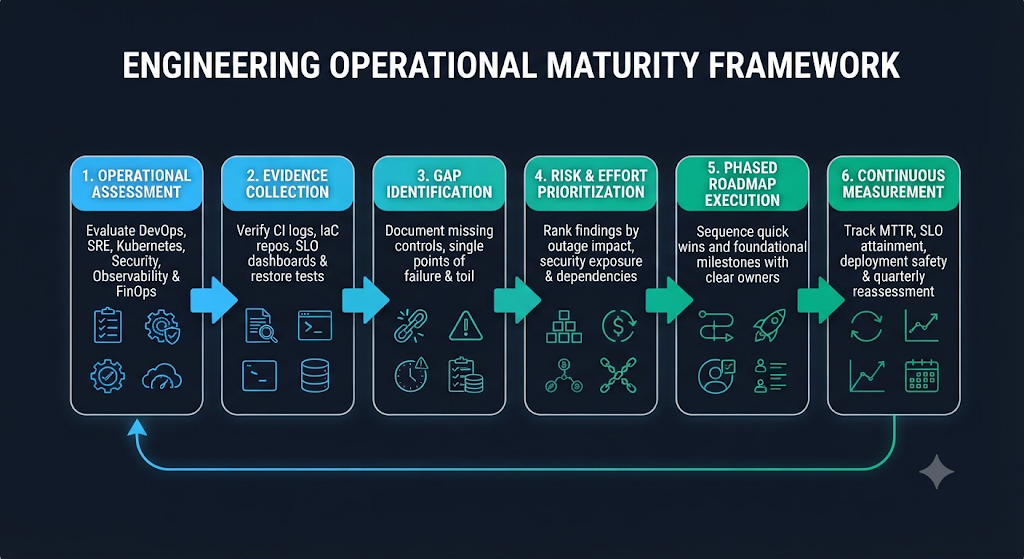
When teams rely on informal confidence or memory-based surveys to judge their operational health, blind spots inevitably survive until an outage exposes them. Conducting a disciplined DevOps maturity assessment requires anchoring every evaluation criterion in observable production artifacts rather than assumptions.
Before launching a new service or migrating critical workloads, teams should execute a structured production readiness assessment backed by concrete evidence:
- Deployment and Rollback Proof: Verify recent pipeline logs demonstrating automated canary or blue/green rollouts and confirm that a rollback has been executed and timed in staging or production.
- Reliability Signals and Alert Hygiene: Inspect live dashboards covering latency, traffic, errors, and saturation, and verify that every paging alert links to a current, actionable runbook.
- Recovery Validation: Check backup configurations for encrypted snapshots and point-in-time recovery, supported by documented results from a recent restoration test rather than an unverified backup schedule.
- Explicit Ownership: Confirm the service is registered in an internal catalog with a named owning team, an active on-call rotation, and documented escalation paths for upstream dependencies.
It is important to distinguish internal maturity scoring and readiness reviews from formal compliance audits or independent regulatory certifications. Self-assessments are diagnostic engineering tools designed to uncover technical gaps and guide internal prioritization—not pass/fail regulatory inspections.
Kubernetes Production Readiness and Practical Troubleshooting
Because Kubernetes underpins much of modern cloud infrastructure, runtime misconfigurations frequently trigger avoidable outages. Applying a standardized Kubernetes production readiness checklist ensures workloads are resilient against node disruptions, resource contention, and cascading restarts:
- Resource Requests and Limits: Define explicit CPU and memory requests so the scheduler places pods accurately, and set memory limits aligned with application runtime ceilings to prevent unexpected node-level out-of-memory kills.
- Isolated Health Probes: Configure
readinessProbeendpoints to verify traffic-serving readiness, keeplivenessProbechecks strictly focused on unrecoverable process deadlocks without calling external databases, and usestartupProbefor slow-booting runtimes. - High Availability and Scaling: Distribute replicas across availability zones using
topologySpreadConstraints, protect voluntary drains withPodDisruptionBudgets, and tuneHorizontalPodAutoscalerstabilization windows. - Network and Secret Hygiene: Enforce default-deny namespace
NetworkPolicieswith explicit allow-lists, disable unnecessary service account token mounting, and inject credentials dynamically from an external secrets manager.
Even well-configured clusters encounter runtime failures, making systematic Kubernetes CrashLoopBackOff troubleshooting an essential skill. When a pod repeatedly cycles between Running, Error, and CrashLoopBackOff, engineers should follow a structured diagnostic sequence rather than blindly restarting workloads:
Bash
# 1. Inspect pod restart counts, status, and node placement
kubectl get pods -n <namespace> -l app=<service-name> -o wide

# 2. Check termination exit codes, Last State reasons, and probe events
kubectl describe pod <pod-name> -n <namespace>

# 3. Retrieve logs from the terminated container instance prior to restart
kubectl logs <pod-name> -n <namespace> --previous
Interpreting those outputs quickly narrows the root cause. Exit code 137 with Reason: OOMKilled indicates the container breached its memory limit, requiring heap profiling or adjusted memory bounds. Exit code 1 points to an application-level startup failure—such as a missing environment variable or malformed configuration file—visible in the --previous log stream. Conversely, if kubectl describe pod shows Killing: Container failed liveness probe, the application did not crash on its own; kubelet terminated a slow-starting or temporarily loaded container because the liveness threshold was overly aggressive.
From Assessment Findings to Prioritized Roadmaps
Uncovering dozens of operational gaps is easy; fixing them without stalling product delivery requires disciplined prioritization. Teams should evaluate each finding across operational risk, customer blast radius, security exposure, implementation effort, and technical dependencies. High-risk, low-effort gaps—such as enabling automated database backups or adding missing container memory limits—belong in immediate sprint work, while multi-quarter architectural shifts require phased execution.
| Maturity Stage | Common Operational Characteristics | Primary Improvement Priorities |
| Stage 1: Ad-Hoc / Reactive | Manual deployments, tribal knowledge, noisy host-level alerts, frequent firefighting, and unattributed cloud spend. | Establish version-controlled CI pipelines, basic golden-signal dashboards, named service ownership, and automated backups. |
| Stage 2: Foundational / Standardized | Consistent CI/CD for core services, basic Kubernetes health checks, documented runbooks, and initial incident roles. | Implement fast automated rollbacks, structured JSON logging, baseline security scanning in PRs, and cost-allocation tagging. |
| Stage 3: Measured / Proactive | User-centric SLOs, distributed tracing across critical paths, blameless postmortems with tracked actions, and self-service templates. | Roll out error-budget policies, automate recurring manual toil, enforce policy-as-code guardrails, and test disaster recovery drills. |
| Stage 4: Optimized / Continuous | High golden-path adoption, automated progressive delivery, unit-cost telemetry, and regular quarterly maturity reassessments. | Refine tail-based telemetry sampling, run proactive chaos/game-day exercises, and continuously evolve platform self-service capabilities. |
Structured roadmaps translate these priorities into realistic sequences tailored to an organization’s current constraints:
- A platform engineering adoption roadmap starts by eliminating repetitive deployment boilerplate through a single paved-road service template before building complex developer portals.
- An SRE adoption roadmap focuses first on deleting non-actionable paging alerts and instrumenting tier-1 user journeys before enforcing strict error-budget freezes.
- A DevSecOps implementation roadmap embeds fast secret and dependency scans into pull requests before introducing blocking runtime admission policies.
- Advancing along an observability maturity model prioritizes consistent
trace_idpropagation across logs and metrics before optimizing high-cardinality sampling. - Maturing an incident management maturity model establishes clear Incident Commander roles and timely blameless postmortems before running complex multi-team chaos simulations.
- A practical cloud cost optimization roadmap enforces resource tagging and shuts down idle non-production clusters before committing to long-term compute reservations.
For teams seeking structured frameworks to organize these evaluations, OpsRoadmaps serves as a practical reference for engineering operational assessments, transparent maturity scoring, and capability-driven improvement roadmaps.
Hypothetical Scenario: Moving from Scattered Practices to a Structured Plan
To see how this works in practice, consider a hypothetical mid-sized SaaS engineering group operating 40 microservices across two Kubernetes clusters. Despite using modern CI tools and a commercial monitoring platform, the team suffered from frequent weekend alerts, 45-minute manual rollbacks, and rising cloud infrastructure costs.
Rather than purchasing additional tooling, the engineering manager and technical leads conducted a two-week operational review grounded in repository configs, alert histories, and deployment logs. The evidence exposed four clear bottlenecks: missing memory limits and startup probes on a third of production services, manual YAML edits required for rollbacks, over 80 non-actionable CPU alerts firing weekly, and untagged staging clusters running continuously overnight.
Using a simple risk-versus-effort matrix, the team sequenced a 90-day improvement plan. During the first 30 days, they enforced baseline pod resource limits, removed noisy CPU alerts, and scheduled automated off-hours shutdowns for staging environments. In days 31 through 60, they standardized GitOps rollback workflows so any service could revert cleanly within four minutes. In days 61 through 90, they introduced distributed tracing across their top five customer-facing APIs and defined initial availability SLOs. Within one quarter, on-call interruptions dropped sharply and release predictability improved—driven entirely by targeted process and configuration discipline.
Conclusion: Making Operational Improvement Continuous
Engineering operations maturity is never a finished destination. Every new service, traffic milestone, or architectural migration introduces fresh operational trade-offs. The organizations that sustain high reliability do not rely on heroic firefighting or one-off audit checklists; they treat operational health as a continuous engineering feedback loop. By grounding evaluations in real production evidence, prioritizing improvements by risk and effort, and measuring progress through concrete reliability and delivery outcomes, engineering teams can turn technical complexity into steady, sustainable progress.
Leave a Reply